Tag: books

The Greatest Short Stories of Anton Chekhov

About the Book

I own the paperback version of The Greatest Short Stories of Anton Chekhov. The book was translated by Constance Garnett who in addition to translating the stories to English also wrote a short bio of Anton Chekhov. This book is 623 pages long and the print is a comfortable 10 pitch so it is easy to read. Most of the stories in the book are just a few pages long with the exception of three or four stories over 20 pages in length. After reading a number of short stories the next one was called “A Dreary Story” and it was 63 pages long. I only noticed maybe a half dozen misprinted words, which was a bit odd to me, but overall the quality of the paperback version is excellent.

Summary

This is a compilation of 50 stories written by Chekhov over about a 20-year period from 1883 through 1903. One of the cool things is that the translator shows when the story was first published and where it was published. While only living 44 years Anton Chekhov wrote 522 stories over his short life and a number of plays. This book as titled is supposed to be a compilation of his greatest stories. To put things in context these stories by Chekhov were written prior to the Bolshevik (Russian) Revolution that started in 1917. There are several things that stand out about Russian society when you are reading these stories.

  • The disparity between the rich and poor was monumental. Many of the people in Russia at that time were serfs or peasants who worked in various trades, but were little more than slaves in Russian society.
  • Alcoholism was rampant in Russia during the late 1800’s. I suspect it is not that much better today.
  • The state of medicine as a profession in comparison to today was abysmal. Life expectancy was 30-35 years much of this due to infant mortality and the state of health care at the time.
  • In many of the stories, characters were thought to be dying of consumption, viruses, fever, alcoholism, and madness.
  • The weather well was as you might expect with long wet winters that made travel on dirt roads that were typical of the period difficult at best.

Of course in the late 1800’s this would not have been unique to Russia and my guess is that many of these issues existed in many parts of the world. However, there is something special about how Chekhov described the plight of his characters. Each story is different and has a special message for the reader. Chekhov had an incredible talent for describing things like the weather, scenery, or the emotions of his characters. In a way, this is not unusual given he was a playwright.

I would typically read one or two stories a day, so if you have limited time this book allows you to read a story and not have to worry about if you remember where you left off as is the case with a novel. The writing is clear and easy to read without some of the complexity you might find with other Russian authors such as Fyodor Dostoevsky. Much of these stories is dialog between characters and there were times I had to figure out who was saying what to who, but that was not a frequent issue. If you are new to reading Russian literature you may be a bit confused about the names, but after a while, you will figure it out. If you want to learn more about Russian names check out this blog post by Janet Fitch, it does a nice job of explaining how Russian names work.

Recommendation

This is one of my favorite books and while it is over 600 pages long the fact that it contains so many interesting stories allows you to consume a story in one sitting and the book as a whole over time without getting lost. Chekhov has a real talent for describing a scene and his characters. You feel like you are being taken back to the Russia of the late 1800s and you are experiencing the joy and tragedy of the characters in the story. I can understand why Tolstoy was such a fan of Chekhov and I will be seeking more of his work to read. Without getting too emotional about Chekhov’s work, I enjoyed reading all 50 stories in this book. I highly recommend this book to anyone who enjoys great writing and wants to go back in time and understand the culture of Russia during that time period. I would put Chekhov right near the top of the greatest Russian writers and maybe the greatest short story writer of all time.

About the Author

There is a nice 4-page bio of Anton Chekhov at the beginning of the book. Chekhov was an extremely influential author and there is a lot of information about his life and his work. I’m going to provide what I found online at Britannica as it seemed the most readable and best organized.

Anton Chekhov Summary

Anton Chekhov, (born Jan. 29, 1860, Taganrog, Russia—died July 14/15, 1904, Badenweiler, Ger.), Russian playwright and short-story writer. The son of a former serf, he supported his family by writing popular comic sketches while studying medicine in Moscow. While practicing as a doctor, he had his first full-length play, Ivanov (1887), produced, but it was not well-received. He took up serious themes with stories such as “The Steppe” (1888) and “A Dreary Story” (1889); later stories include “The Black Monk” (1894) and “Peasants” (1897). He converted his second long play, The Wood Demon (1889), into the masterpiece Uncle Vanya (1897). His play The Seagull (1896) was badly received until its successful revival in 1899 by Konstantin Stanislavsky and the Moscow Art Theatre. He moved to the Crimea to nurse his eventually fatal tuberculosis, and there he wrote his great last plays, Three Sisters (1901) and The Cherry Orchard (1904), for the Moscow Art Theatre. Chekhov’s plays, which take a tragicomic view of the staleness of provincial life and the passing of the Russian gentry, received international acclaim after their translation into English and other languages, and as a short-story writer, he is still regarded as virtually unmatched. https://www.britannica.com/summary/Anton-Chekhov

As I mentioned Britannica has an extensive biography on Anton Checkhov with some very interesting information about the stages of his life and career. https://www.britannica.com/biography/Anton-Chekhov

I would also point you to Wikepedia who also has some great information on the life and work of Anton Chekhov. https://en.wikipedia.org/wiki/Anton_Chekhov

Please check out my companion blog The Stoic Buddhist

“Copyright 2024 InspirationalBookReviews.com. All Rights Reserved”

Please Subscribe if you are not already following me.

Same as Ever

About the Book

The above book is my copy of Same as Ever written by Morgan Housel. Just a note I did read his first book The Psychology of Money. It has been a while since writing my last book review on the Tipping Point. I haven’t been hiding but was instead involved in somewhat of a death march project at work. Well, all of that is over now and I retired so you will have to hear from me from time to time as I get back to the important things. Hopefully by providing some reading options for you and my insights into the books.

I read the hardcopy version of Same as Ever that I purchased for $18.75. I prefer to buy the hardcover version because it is more durable than a paperback book. The type is above average and I would say about 10-point font making it very readable. The actual length of the book excluding the acknowledgements and notes is 203 pages and can easily be read in 2 or 3 days.

If you have read any of my other book reviews you know that I don’t go into excruciating detail regarding the contents of the book, but instead focus on summarizing the book, what I liked and disliked, my recommendation, and some information about the author. My goal is to help you decide if the book is something you should invest your time reading. “I’m here to enhance your experience, but remember, 90% of the fun is in reading the book yourself.”

Summary

In a sentence what this book is really about is what doesn’t change in a world that is changing all the time. Most of these stories provide insights into human behavior that is the same today as it was a hundred years ago. So the author has really put together a series of stories that focus on universal truths that can help guide your decisions. Some of the themes regarding these universal truths include:

  • The world hangs on a thread. You and I are a decision away from safety or oblivion.
  • Risk is what you don’t see coming. Think of the Great Depression starting in 1929 or September 11th, 2001.
  • We all have unrealistic expectations and they tend to be relative to someone else. “Investor Charlie Munger once noted that the world isn’t driven by greed; it’s driven by envy.” p. 26
  • There are some very unique people that we admire, but like us they are flawed in some way that we don’t like. The lesson is you kind of have to accept the whole person, not just their admirable traits.
  • The best story always wins, not the best idea, but the best story and storyteller. Dr. King’s famous speech “I have a dream”. The funny thing is that he went off script that day and began ad-libbing and the rest is history.
  • Growth happens over time kind of like compound interest, but a catastrophe can occur in the blink of an eye. Think Pearl Harbor, September 11th, or Covid-19.
  • The author called this chapter The Casualties of Perfection, but the philosophy outlined is more about not over scheduling yourself and leaving free time to really think about things instead of worrying that you are productive every hour of every day.

I’m only including a sampling of some of the themes you get from the book there are many more to explore.

Recommendation

The book is easy to read, and it contains some great quotes and supporting information for his theories on what he calls universal truths. Just like his first book The Psychology of Money, it left me without anything actionable to take away from it. The stories he told were interesting, but lacked any great insights. If I took anything away from reading the book is that life is much more precarious than one might think. While this is an entertaining read it is not something I would recommend as an inspirational book.

About the Author

I couldn’t find a lot of information about the author. The information below came from Audible.com.

Morgan Housel is a partner at The Collaborative Fund. He is a two-time winner of the Best in Business Award from the Society of American Business Editors and Writers, winner of the New York Times Sidney Award, and a two-time finalist for the Gerald Loeb Award for Distinguished Business and Financial Journalism. He lives in Seattle with his wife and two kids.

“Copyright 2024 InspirationalBookReviews.com. All Rights Reserved”

Please check out my companion blog TheStoicBuddhist.com

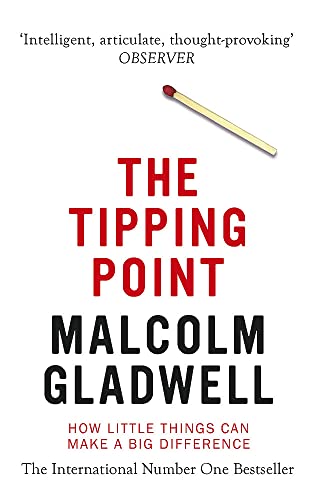
The Tipping Point

Summary

The Tipping Point by Malcom Gladwell it the 4th or 5th book I’ve read from this author. The book is only about 260 pages, quality printing and the font is decent size, making it easy to read for almost everyone. If you haven’t read Malcom Gladwell before, you are missing out. He has an easy to read writing style and I’ve found his books are very well researched.

Like all my other book reviews, I will summarize the primary themes in the book, but I don’t want to spoil it for you with a review that outlines all the chapters. Hopefully, I will provide enough information that helps you make a decision of whether you want to invest your time reading it. I will also provide my recommendation which consists mostly about why you might want to read this book. Finally I’ll provide some information about the author.

The Tipping Point is a book about how an idea, sometimes referred to as an epidemic tips or spreads, often very fast. There are three key roles that help to create the tipping point including Mavens, Connectors, and Salesmen. When an idea tips, a change has occurred in one or more of three areas:

  • Law of the Few
  • Stickiness Factor
  • Power of Context

As I mentioned above a tipping point relies on the three roles mentioned above. A brief description of them would include:

  1. Connector – Connectors know lots of people and have a special gift for bringing the world together. “Sprinkled among every walk of life, in other words, are a handful of people with truly extraordinary knack of making friends and acquaintances. They are Connectors.” p. 41
  2. Maven – A Maven is one who accumulates knowledge. “These are the people who keep the marketplace honest. In the ten years or so since this group was first identified economists have gone to great lengths to understand them. They have found them in every walk of life and in every socioeconomic group. One name for them is price vigilantes. The other, more common, name for them is Market Mavens.” p. 61
  3. Salesmen – Salesman have the skills to persuade and are critical to creating word of mouth tipping points. They have enthusiasm, energy, and likeability that make them irresistible.

As I mentioned I won’t go into great detail reviewing this book, but the Power of Context was interesting to me in that a lot of ideas and tipping points thrive because of their environment. One of the examples was this that Gore Associates a privately held company in Delaware that makes Gore-Tex fabric, dental floss, and a number of specialty items has found an organizational construct that works for them. This contextual construct is called the Rule of 150. The Rule of 150 provides the guideline for the size of a group of people and any group greater than 150 people will suffer problems in communication, leadership, and the ability to innovate. Gore Associates takes this seriously and makes sure that their business can be sub divided with this number in mind, keeping plants smaller, and this allows more decision making and autonomy within this relatively smaller group of people. Having worked in very large groups sometimes in the thousands, it is not hard to understand how this would foster teamwork, communication, and just a better quality work life.

This whole book focuses on how epidemics are created, what was the tipping point and how the Law of the Few, Stickiness Factors, and the Power of Context factor into rapid change or tipping point.

Recommendation

I’ve read several other of Malcom Gladwell’s books including David and Goliath, Outliers, and Blink. While it is hard to dislike any of Mr. Gladwell’s books because he has a great writing style and as I mentioned before seems to do a lot of research to support his work. In this case it was a bit more difficult for me to enjoy the whole book. I often found myself speed reading some of the chapters to get to the next one, as I became somewhat bored by all the examples that were used to make a point. Here is the thing, if you are interested in how trends get started or why something may be a success from a commercial perspective then this is a good book for you. I think if you are in Marketing or Social Media or in some other profession where you want to persuade people then by all means read this book. It just wasn’t my cup of tea.

About the Author

English-born Canadian journalist, author, and speaker Malcolm Timothy Gladwell is known for his articles and books that identify, approach and explain the unexpected implications of social science research. In addition to his writing work, he is the podcast host of Revisionist History.

Early Life

Malcolm Gladwell was born on September 3, 1963, in Fareham, Hampshire, England to a father who was a mathematics professor, Graham Gladwell, and his mother Joyce Gladwell, a Jamaican psychotherapist. Gladwell grew up in Elmira, Ontario, Canada. He studied at the University of Toronto and received his bachelor’s degree in History in 1984 before moving to the U.S. to become a journalist. He initially covered business and science at the Washington Post where he worked for nine years. He began freelancing at The New Yorker before being offered a position as a staff writer there in 1996. 

Malcolm Gladwell’s Literary Work

In 2000, Malcolm Gladwell took a phrase that had up until that point been most frequently associated with epidemiology and single-handedly realigned it in all of our minds as a social phenomenon. The phrase was “tipping point,” and Gladwell’s breakthrough pop-sociology book of the same name was about why and how some ideas spread like social epidemics. became a social epidemic itself and continues to be a bestseller.

Gladwell followed with Blink (2005), another book in which he examined a social phenomenon by dissecting numerous examples to arrive at his conclusions. Like The Tipping PointBlink claimed a basis in research, but it was still written in a breezy and accessible voice that give Gladwell’s writing popular appeal. Blink is about the notion of rapid cognition — snap judgments and how and why people make them. The idea for the book came to Gladwell after he noticed that he was experiencing social repercussions as a result of growing out his afro (prior to that point, he had kept his hair close-cropped).

Both The Tipping Point and Blink were phenomenal bestsellers and his third book, Outliers (2008), took the same bestselling track. In Outliers, Gladwell once again synthesizes the experiences of numerous individuals in order to move beyond those experiences to arrive at a social phenomenon that others hadn’t noticed, or at least hadn’t popularized in the way that Gladwell has proved adept at doing. In compelling narrative form, Outliers examines the role that environment and cultural background play in the unfolding of great success stories.

Gladwell’s fourth book, What the Dog Saw: And Other Adventures (2009) gathers Gladwell’s favorite articles from The New Yorker from his time as a staff writer with the publication. The stories play with the common theme of perception as Gladwell tries to show the reader the world through the eyes of others – even if the point of view happens to be that of a dog.

His most recent publication, David and Goliath (2013), was inspired in part by an article that Gladwell penned for The New Yorker in 2009 called “How David Beats Goliath.” This fifth book from Gladwell focuses on the contrast of advantage and probability of success amongst the underdogs from varying situations, the most well-known story concerning the biblical David and Goliath. Although the book didn’t receive intense critical acclaim, it was a bestseller and hit No. 4 on The New York Times hardcover non-fiction chart, and No. 5 on USA Today‘s best-selling books. 

Reference: https://www.thoughtco.com/profile-of-malcolm-gladwell-851807

Please check out my companion blog “TheStoicBuddhist.com

“Copyright 2023 InspirationalBookReviews.com. All Rights Reserved”

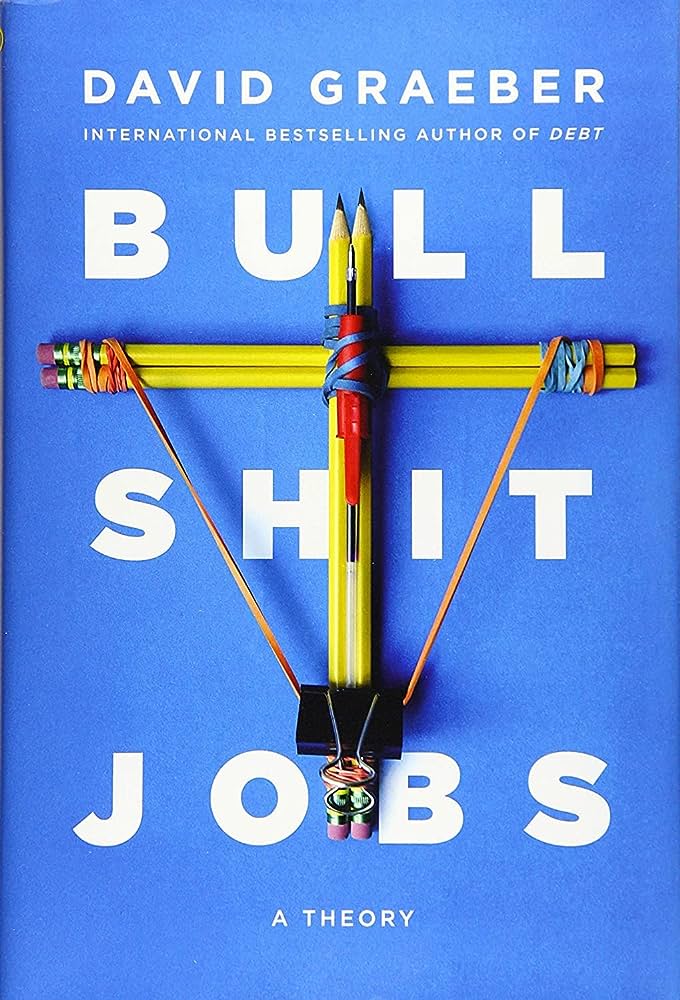
Bullshit Jobs

Summary

I read this book a few months ago called Bullshit Jobs by David Graeber. What led me to read the book was most likely something I had seen on YouTube. Here is an example on YouTube of David Graeber explaining 5 types of Bullshit jobs:

The paperback book I read was almost 300 pages long without the Notes section at the end. The book was printed well with a font a little on the small size, maybe a 9 or 10 pitch, but readable. The author starts in the first chapter defining what a “Bullshit” job is.

Having worked in corporations for the vast majority of my life I had seen my own share of bullshit jobs up close and personal. The author goes on in subsequent chapters to elaborate on what kinds of jobs are bullshit jobs, why most people that have a bullshit job are unhappy, what it is like to have a bullshit job, and why are bullshit jobs proliferating. After you have a good understanding of what these bullshit jobs are the author in Chapter 6 and 7 goes into a decent amount of detail into what impact these jobs have on society.

There is also what the author calls the working definition of a bullshit job.

Provisional Definition: a bullshit job is a form of employment that is completely pointless, unnecessary, or pernicious that even the employee cannot justify its existence.

One of the things that Mr. Graeber elaborates on is the rise of the management role in industrialized capitalism. This of course created its own layer of bullshit jobs as management roles proliferated and left the actual producers (people doing the work) with almost zero autonomy.

Working Definition: a bullshit job is a form of paid employment that is so completely pointless, unnecessary, or pernicious that even the employee cannot justify its existence even though, as part of the conditions of employment, the employee feels obliged to pretend that this is not the case.

Of course bullshit jobs do not only exist in our capitalist enterprises. Academia has taken what used to be a Dean and the majority of employee’s at a university being faculty to what exists today more administrators than faculty.

What the hell?

Wonder why your tuition is so expensive?

Graeber also goes into detail on how these bullshit jobs invent processes that justify their existence such as multiple levels of approvals, pointless reports, and metrics with little to no meaning. Such is the surge in organizational bloat. So instead of donating the profits to charities, paying the real workers more, or investing into capital equipment, the modern goliath of a company builds additional layers and can’t understand why they are not more profitable and nimble.

Recommendation

I would recommend this book to most people that want to learn more about what is going on in corporate, government, and educational institutions. If you were starting a business you might look at this book as uncovering what you don’t want to do. For me it confirmed a lot of things I had thought for some time, but I also learned a lot about what these types of jobs do to the people that hold them.

The fact that we as a society are so utterly oblivious to the existence of these bullshit jobs is very telling. They say we are approaching a demographic tipping point, where in many countries we are not replacing the elderly with sufficient amounts of younger people to be consumers, drive growth, and work for our institutions. If this is so then maybe this will become the demise of bullshit jobs as we know it today.

Why is it we get so much satisfaction from accomplishing real work on the weekends, such as doing lawn work, building something? Is it because the work we do is often mundane and meaningless?

About the Author

David Rolfe Graeber; (February 12, 1961 – September 2, 2020) was an American anthropologist and anarchist activist. His influential work in economic anthropology, particularly his books Debt: The First 5,000 Years (2011), Bullshit Jobs (2018), and The Dawn of Everything (2021), and his leading role in the Occupy movement, earned him recognition as one of the foremost anthropologists and left-wing thinkers of his time.

Born in New York to a working-class Jewish family, Graeber studied at Purchase College and the University of Chicago, where he conducted ethnographic research in Madagascar under Marshall Sahlins and obtained his doctorate in 1996. He was an assistant professor at Yale University from 1998 to 2005, when the university controversially decided not to renew his contract before he was eligible for tenure. Unable to secure another position in the United States, he entered an “academic exile” in England, where he was a lecturer and reader at Goldsmiths’ College from 2008 to 2013, and a professor at the London School of Economics from 2013.

In his early scholarship, Graeber specialized in theories of value (Toward an Anthropological Theory of Value, 2002), social hierarchy and political power (Fragments of an Anarchist Anthropology, 2004, Possibilities, 2007, On Kings, 2017), and the ethnography of Madagascar (Lost People, 2007). In the 2010s he turned to historical anthropology, producing his best-known book, Debt: The First 5000 Years (2011), an exploration of the historical relationship between debt and social institutions, as well as a series of essays on the origins of social inequality in prehistory. In parallel, he developed critiques of bureaucracy and managerialism in contemporary capitalism, published in The Utopia of Rules (2015) and Bullshit Jobs (2018). He coined the concept of bullshit jobs in a 2013 essay that explored the proliferation of “paid employment that is so completely pointless, unnecessary, or pernicious that even the employee cannot justify its existence”.

Although exposed to radical left politics from a young age, Graeber’s direct involvement in activism began with the global justice movement of the 1990s. He attended protests against the 3rd Summit of the Americas in Quebec City in 2001 and the World Economic Forum in New York in 2002, and later wrote an ethnography of the movement, Direct Action (2009). In 2011, he became well known as one of the leading figures of Occupy Wall Street and is credited with coining the slogan “We are the 99%“. His later activism included interventions in support of the Rojava revolution in Syria, the British Labour Party under Jeremy Corbyn and Extinction Rebellion.

David Graeber died unexpectedly in September 2020, while on vacation in Venice. His last book, The Dawn of Everything: A New History of Humanity, co-written with archaeologist David Wengrow, was published posthumously in 2021.[5]

Reference: https://en.wikipedia.org/wiki/David_Graeber

Namaste

Let me know if you think you have a bullshit job.

Please check out my companion blog TheStoicBuddhist.com

Copyright 2023 InspirationalBookReviews.com. All Rights Reserved

The Alchemist – Book Review

I decided to read The Alchemist by Paulo Coelho because of so many recommendations I encountered in my reading and possibly from something I saw on YouTube. As with the majority of my reviews I am not going to spoil the book for you by giving you a blow by blow commentary, but focus more on what I perceive as the reasons you should consider reading it.

Book Quality

Before I provide a brief summary of the book I wanted to discuss the physical aspects of the hard cover version I read. Overall the book is very high quality from the cover, quality of the pages, and type. The size of the book is just right 8 1/2 inches high and about 6 inches wide. As mentioned the type quality is pretty good and probably about 11 pitch making the 176 pages easy to read. This version of the book by Paulo Coelho  (Author), was published by HarperCollins translated by Alan R. Clarke, can be found at Amazon costing a bit more than $22 USD and strangely enough the same book in paperback was $27 USD. The author Paulo Coelho has written many books; more about him in the section About the Author below. Buy the hardcover version, the Alan R. Clarke translation; you won’t regret it.

Summary

To start out with The Alchemist was written as a fictional story first, more specifically it is the story of a shepherd boy named Santiago that is on a journey to follow his dreams. His adventures take him far from his home where he meets a number of very interesting characters, and during his travels he experiences a number of personal revelations. While this is a good story, the book has several themes, which are intended to be teaching moments. Some of those key themes include:

  • Our propensity to give up on dreams and call it fate
  • When you want something bad enough the universe conspires to help you achieve it (Law of Attraction)
  • Faith and the importance of religion
  • The importance of pursuing your dreams
  • Omens as a guide on your journey through life
  • How following your dreams is about what you become
  • Life, conflict, and death

This book is only 176 pages long, so something you could read in a day or two. There are some interesting, almost mystical characters that the boy encounters during his adventure. At the end of the book there is an Epilogue and a brief section about our author.

Recommendation

I really enjoyed reading this book and think it lives up to the hype that I had heard about it. I feel that it belongs on this blog site as it is inspirational, has some fairly profound messages, and is fun read. The author paints a picture of this fantastical journey for our hero Santiago. It is really a story about personal growth and the attainment of your dreams.

As often happens to us from time to time we need some inspiration to to either begin or continue following our dreams, The Alchemist can provide that to you. I read the book over a couple of days and couldn’t put it down. In addition to enjoying a good story, I also found inspiration in the numerous not so subtle messages conveyed by the author.

As I mentioned in my opening paragraph I am hesitant to go into the plot, explaining this story in a lot of detail as especially in this case of this book, it would ruin it for you. Reading is about discovery and this story flows and builds upon itself, and if you know all the characters and how it turns out, well then you just won’t enjoy it as much. With that said, if you need a little kick in the ass to start following your dreams, then I would highly recommend The Alchemist.

Note: If you enjoy The Alchemist and I think you will, there is a companion book called Warrior of the Light that I have yet to read, but it is next up for me from the Paulo Coelho library. Here is a little overview from a page on Amazon:

Warrior of the Light is a timeless and inspirational companion to The Alchemist—an international bestseller that has beguiled millions of readers around the world. Every short passage invites us to live out our dreams, to embrace the uncertainty of life, and to rise to our own unique destiny. In his inimitable style, Paulo Coelho helps bring out the Warrior of the Light within each of us. He shows readers how to embark upon the way of the Warrior: the one who appreciates the miracle of being alive, the one who accepts failure, and the one whose quest leads to fulfillment and joy.

Namaste

About the Author

Paulo Coelho de Souza born 24 August 1947) is a Brazilian lyricist and novelist and a member of the Brazilian Academy of Letters since 2002. His novel The Alchemist became an international best-seller and he has published 28 more books since then.

Biography

Paulo Coelho was born in Rio de Janeiro, Brazil, and attended a Jesuit school. At 17, Coelho’s parents committed him to a mental institution from which he escaped three times before being released at the age of 20. Coelho later remarked that “It wasn’t that they wanted to hurt me, but they didn’t know what to do… They did not do that to destroy me, they did that to save me.” At his parents’ wishes, Coelho enrolled in law school and abandoned his dream of becoming a writer. One year later, he dropped out and lived life as a hippie, traveling through South America, North Africa, Mexico, and Europe and started using drugs in the 1960s.

Upon his return to Brazil, Coelho worked as a songwriter, composing lyrics for Elis Regina, Rita Lee, and Brazilian icon Raul Seixas. Composing with Raul led to Coelho being associated with magic and occultism, due to the content of some songs. He is often accused that these songs were rip-offs of foreign songs not well known in Brazil at the time. In 1974, by his account, he was arrested for “subversive” activities and tortured by the ruling military government, who had taken power ten years earlier and viewed his lyrics as left-wing and dangerous. Coelho also worked as an actor, journalist and theatre director before pursuing his writing career.

Coelho married artist Christina Oiticica in 1980. Together they had previously spent half the year in Rio de Janeiro and the other half in a country house in the Pyrenees Mountains of France, but now the couple reside permanently in Geneva, Switzerland.

In 1986 Coelho walked the 500-plus mile Road of Santiago de Compostela in northwestern Spain. On the path, he had a spiritual awakening, which he described autobiographically in The Pilgrimage. In an interview, Coelho stated “[In 1986], I was very happy in the things I was doing. I was doing something that gave me food and water – to use the metaphor in The Alchemist, I was working, I had a person whom I loved, I had money, but I was not fulfilling my dream. My dream was, and still is, to be a writer.” Coelho would leave his lucrative career as a songwriter and pursue writing full-time.

The Pilgrim – Story of Paulo Coelho is the international title for the biographical film Não Pare na Pista, a co-production between Brazil’s Drama Films and the Spanish Babel Films, in which the younger and older Coelho are played by two different actors. One of the producers, Iôna de Macêdo, told Screen International: “The film tells the story of a man who has a dream. It’s a little like Alice in Wonderland – he’s someone who is too big for his house.” The film, shot in Portuguese, had its premiere in Brazilian theaters in 2014 and was internationally distributed in 2015.

Read more about the author and a complete list of his books: https://en.wikipedia.org/wiki/Paulo_Coelho

“Copyright 2023 InspirationalBookReviews.com. All Rights Reserved”

Please check out my companion blog TheStoicBuddhist.com

In the Buddha’s Words

Summary

This review of “In the Buddha’s Words” will undoubtedly be a bit longer than many of my other posts. If you haven’t guessed by now I am more than a little interested in Buddhism, which you can find out more about on my other blog thestoicbuddhist. I have the soft cover version of the book, which is 485 pages. The books has high quality print and the font is not too small, making it very readable. The book starts out with a forward by the Dalai Lama, then a preface, list of abbreviations, key to pronunciation in Pali, and a detailed list of the contents of the book. This is a scholarly explanation and exploration of discourses in the Pali Canon. The book is divided into 10 sections and each section includes a somewhat lengthy introduction that helps provide a better understanding of the the text in the Pali Canon.

The Pali Canon represents the words of the Buddha, more specifically his teachings, which his followers had committed to memory and recited to each other. Within the Pali Canon texts know as the Nikayas are the earliest cohesive collection of the Buddha’s teaching in his own words. The preface goes into a lot of great detail about how the Pali Cannon is organized and a good bit of history. Bikkhu Bodhi hand selected the texts for this book and has ordered the chapters in a way that build upon each other. To give you an idea of the concepts that are included in the book here are the 10 sections:

  1. The Human Condition
  2. The Bringer of Light
  3. Approaching the Dhamma
  4. The Happiness Visible In This Present Life
  5. The Way To A Fortunate Rebirth
  6. Deepening One’s Perspective On The World
  7. The Path To Liberation
  8. Mastering The Mind
  9. Shinning The Light Of Wisdon
  10. The Planes Of Realization

Of course I could not help myself from bookmarking and highlighting some of the Buddha’s teachings, such as in Chapter 3 Approaching The Dhamma on page 88:

“These three things, monks, are conducted in secret, not openly. What three? Affairs with women, the mantras of the brahmins, and wrong view. But these three things, monks, shine openly, not in secret. What three? The moon, the sun, and the Dhamma and Discipline proclaimed by the Tathagata.”

Without going into all the details the Buddha speaks of the Five Precepts in Chapter 5, The Way To A Fortunate Rebirth, page 173. Note: I am using the location in the book and not in the Pali Canon.

“There are further, monks, these five gifts pristine, of long standing, traditional, ancient, unadulterated and never before adulterated, that are not being adulterated and that will not be adulterated, not despised by wise ascetics and brahmins. What are these five gifts?”

“Here, monks, a noble disciple gives up the destruction of life and abstains from it.”

“Further monks, a noble disciple gives up the taking of what is not given, and abstains from it.”

“Further monks, a noble disciple gives up sexual misconduct and abstains from it.”

“Further monks, a noble disciple gives up false speech and abstains from it.”

“Further monks, a noble disciple gives up wines, liquors, and intoxicants, the basis for negligence, and abstains from them.”

There are many of the Buddha’s teachings to numerous to mention contained in this book, along with The Four Noble Truths and the Eightfold path as you would expect. In explaining the difference between the Tathagata (Buddha) and a monk liberated by wisdom, the Buddha said:

“The Tathagata, monks, the Arahant, the Perfectly Enlightened One, is the originator of the path unarisen before, the producer of the path unproduced before, the declarer of the path undeclared before. He is the knower of the path, the discoverer of the path, the one skilled in the path. And his disciples now dwell following that path and become possessed of it afterward.”

Recommendation

I really enjoyed reading this book and the author Bhikkhu Bodhi does a great job of setting up sections of the book mentioned above. His introductions are quite lengthy and I sometimes found myself skipping some of this text in a hurry to read what the Buddha had to say. If someone was new to Buddhism, I would not recommend this book as there are many other books that are easier to read that would prepare someone for what is basically excerpts from the Pali Canon. For the novice of Buddhism, you will not be introduced to the history of Buddhism or various flavors of Buddhism, but if you already have a good grasp of the religion then I would recommend this book to you. On reading the text presented from the Pali Cannon, you will find that the Buddha’s teaching contained a lot of repetition that can sometimes be painful to read, but this is easily overcome as you can skip ahead to the next paragraph.

Overall this is a great presentation of selected texts from the Pali Canon organized in a logical fashion. It is obvious that the author has an in-depth knowledge of the books (Nikayas) that make up the Pali Canon. For me this was an opportunity to read what the Buddha said, not some modern day interpretation of what the Buddha said. If you are a student of Buddhism, I would classify this as a must read. This is a book that you can read over and over again, providing new insights with each reading.

Namaste

Check out my companion blog The Stoic Buddhist for more on Buddhism, Philosophy, and Stoicism.

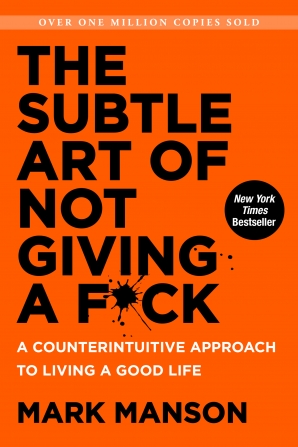
The Subtle Art Of Not Giving A F*ck

Overview

Well here we go again, another book making use of the word Fuck. You might remember another book review I did on Unfu*ck Yourself by Gary John Bishop. This book The Subtle Art Of Not Giving A Fuck by Mark Manson was a book I read partially a couple years ago. More recently I ran into a review of this book on YouTube by the author and decided to give it another try. It turns out this book is pretty good and kind of got me out of a funk I was feeling.

Don’t let the title fool you, it’s not about meandering your way through life and not giving a shit about anything, far from it. One of the key messages is stop giving a fuck about everything. When you give a fuck about all the little things in life, you lose focus on what is really important. The author encourages you to seek out your values and ruthlessly give a fuck about them, but stop giving a fuck about all the other bullshit that is occurring around you. In the span of a few sentences I have said the “F” word way too many times. Let’s take this in another direction and substitute care for fuck.

These values may relate to some aspect of your work, spending more time with your family, a hobby your are passionate about, or anything you consider important, with the caveat that it cannot be everything. That’s the problem if you care about everything you drive yourself and everyone around you crazy.

Another key concept in the book is this idea that we are all pursuing happiness often via pleasurable or hedonistic experiences. You know spending time on vacation, drinking, smoking pot, chasing men or women, or buying shit. All of these things seem fine for a while, but ultimately leave us feeling somewhat empty and consequently we really aren’t all that happy. The author contends it is the challenges in life that present us with problems to solve that truly makes us happy. It’s not that happiness is bad, but the fact that we value it so much and we orient our lives to try to achieve some constant state of happiness that is the issue. Maybe it’s really those times where you achieved something like getting that job you wanted, pursuing a degree, starting that business that took 2 years to become profitable, or any other goal you had set that aligned with your values that really brought you a sense of satisfaction. It was the struggle, overcoming the problems, and this is where you look back and say this thing I achieved brought me happiness.

There are some other interesting topics explored in this book that reinforces the two concepts we just explored, like you are always making choices, suffering is underrated, failing is good, your not really that special, and we all die in the end. Listen, I don’t want to spoil things for you by reviewing every chapter, so I’m going to leave the rest for you to discover.

Recommendation

If you can get by the first couple chapters of using the “F” word in mega doses then I would recommend you read this book. I have the hardcover version and the type is decent size and the book itself is of high quality. Mark Manson interjects a fair amount of humor in his writing, so not only are you learning, also but being entertained at the same time. Here’s the thing he is brutally honest about the fact that we seem to be seeking a life of bliss, when in reality life has way more suffering and overcoming obstacles in store for all of us. This is not a self help book to help you make more money or reach Nirvana, but instead kind of a kick in the ass to help you set your priorities and determine what the hell is important to you. Once you have done this you can truly not give a fuck about some of those things that annoying the hell out of you on a day to day basis.

If you have read this book, I would love to hear your take on it, so just drop me a comment.

Namaste

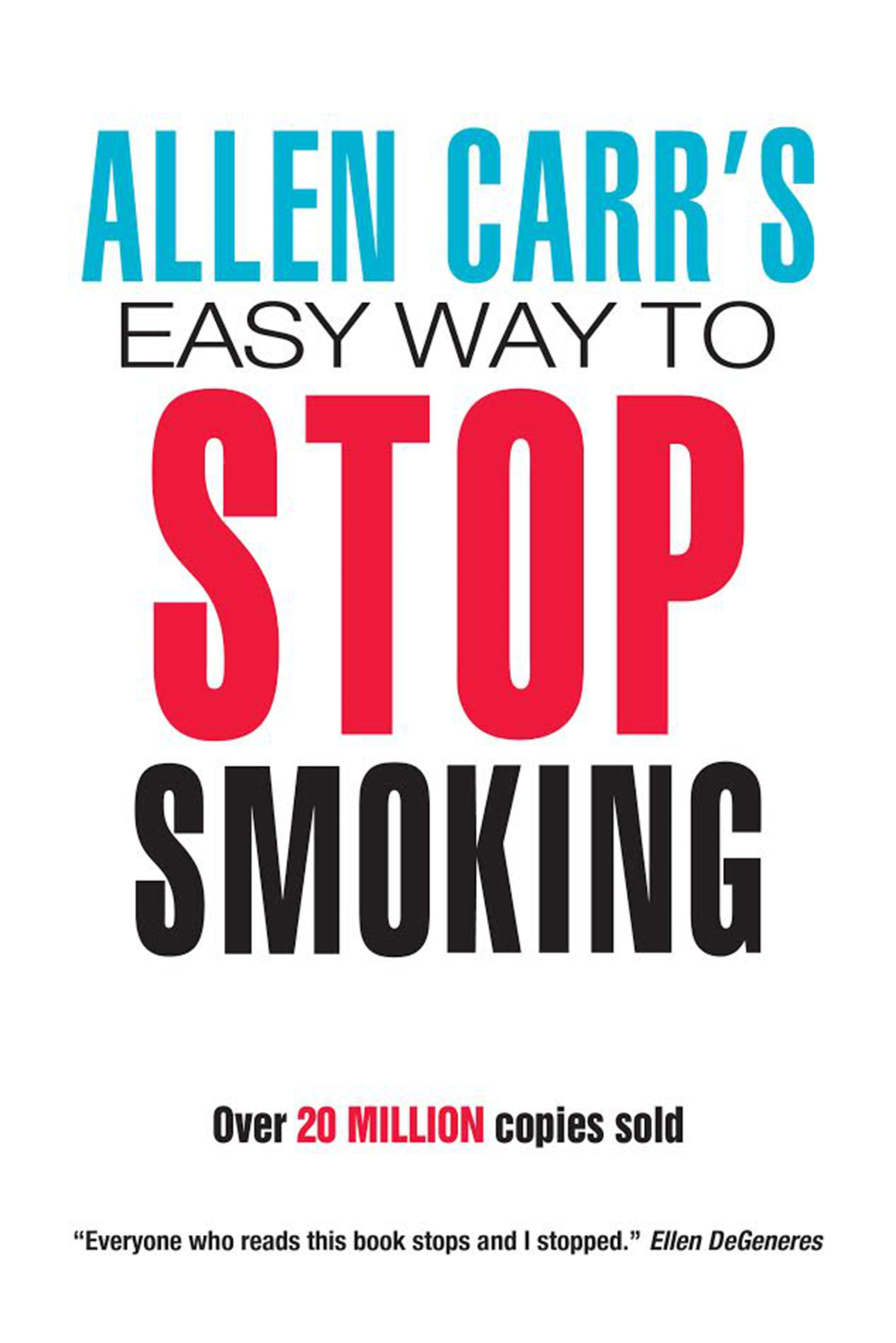
Allen Carr’s Easy Way To Quit Smoking

Allen Carr's Easy Way To Stop Smoking

Summary

If you are a smoker, you might have entertained quitting, and you may be aware of the book that Allen Carr wrote called Easy Way To Stop Smoking. Now if you are not a smoker, but know someone who would benefit from quitting, then read on. I just finished the Kindle version of the book, but have also read the paperback version which is a little over 200 pages long. The premise of the book is that we continue to smoke because we don’t really understand why and that we perceive we are getting some positive benefit from smoking. He talks about the Little Monster and the Big Monster a lot in this book. The Little Monster being the addiction to nicotine and the Big Monster being our psychological dependence on smoking, with the Little Monster being a mere 1% of the problem, and the Big Monster being 99% of the problem. Now given that I’ve read this book three times, I might be a bit slow on the uptake, but you know they say three times is a charm. He goes on to cite all the people that he has helped quit smoking, some of them celebrities.

The author also makes a great point that using nicotine replacement therapy as it is called, is flat out bullshit. Why would you want to continue to feed the Little and Big Monsters and keep yourself a prisoner to the physical and psychological addiction by putting nicotine in your body, then as the levels drop having to do it over and over. Having experience doing this myself, I can tell you it is a losing proposition that just perpetuates the addiction.

He encourages you to keep smoking while you are reading the book, which I found be a reasonable, if a not so subtle way for you to analyze why you’re are smoking and if you are really getting any pleasure out of it. His own realization came after decades of smoking two packs a day. He finally realized why he was smoking and understood the fact that he received not a single benefit from it, and just stopped cold turkey. He went on to share this realization with other people, writing this book and opening Allen Carr
Quit Smoking Centers all over the world.

What I liked about this book

This book helps you understand that fear is keeping  you hostage to this addiction. You think if I quit I will suffer, when the truth is the nicotine addiction is really fairly mild to overcome. The suffering is mostly the psychological relationship you have developed over the years with smoking. He rightly points out that there are no positive attributes to smoking and the mild relief you get when you light up is just satisfying the addiction. He goes to great pains in the book to repeatedly enforce his ideas about the physical and psychological addiction and how to rephrase them. One of the core themes is that you don’t need willpower to quit, because by the end of this book you realize that willpower would only be necessary if you felt you were giving up something that was beneficial to you in some way.

What I disliked about this book

The book is very repetitive and probably could have been half the length without all the repetition, but realize much of this repetition is a form of brainwashing to get you to rethink what smoking really is. The idea that you keep smoking while reading the book until you get to what he calls your last cigarette is somewhat dis-concerning, but there is also a purpose for this, which is to make you analyze what is going on as you continue to smoke.

Recommendation

If you or someone you know is addicted to smoking or vaping then this book is for you. This book re-frames the whole way you think about smoking or vaping. That is the key to the success of this approach; so instead of thinking quitting is too hard, you understand it is not that hard and there is great hope in knowing you are giving up nothing, well at least nothing but a dirty, addictive, and health destroying habit. I highly recommend this book, but with the caveat that you not skip chapters and be in too big a hurry. Let the information sink in and re-frame your thoughts. Good luck!

Namaste


If you would like to support this blog, you can purchase this book at:

eBooks.com

Allen Carr’s Easy Way To Stop Smoking


About the Author

Allen Carr (2 September 1934 – 29 November 2006) was a British author of books about stopping smoking and other psychological dependencies including alcohol addiction. He stopped smoking after 30 years as a hundred-a-day chain smoker.[2]

London-born Carr started smoking while doing National Service aged 18. He qualified as an accountant in 1958. Carr finally stopped smoking on 15 July 1983, aged 48, after a visit to a hypnotherapist. However, it wasn’t the hypnotherapy itself that enabled him to stop – “I succeeded in spite of and not because of that visit” and “I lit up the moment I left the clinic and made my way home…”. There were two key pieces of information that enabled Allen to stop later that day. First, the hypnotherapist told him smoking was “just nicotine addiction”, which Allen had never perceived before that moment, i.e. that he was an addict. Second, his son John lent him a medical handbook which explained that the physical withdrawal from nicotine is just like an “empty, insecure feeling”.[3] He claims that these two realisations crystallised in his mind just how easy it was to stop and so then enabled him to follow an overwhelming desire to explain his method to as many smokers as possible.[4]

Carr teaches that smokers do not receive a boost from smoking a cigarette, and that smoking only relieves the withdrawal symptoms from the previous cigarette, which in turn creates more withdrawal symptoms once it is finished. In this way the drug addiction perpetuates itself. He asserted that the “relief” smokers feel on lighting a cigarette, the feeling of being “back to normal”, is the feeling experienced by non-smokers all the time. So that smokers, when they light a cigarette are really trying to achieve a state that non-smokers enjoy their whole lives. He further asserted that withdrawal symptoms are actually created by doubt and fear in the mind of the ex-smoker, and therefore that stopping smoking is not as traumatic as is commonly assumed, if that doubt and fear can be removed.

At Allen Carr Clinics during stop-smoking sessions, smokers are allowed to continue smoking while their doubts and fears are removed, with the aim of encouraging and developing the mindset of a non-smoker before the final cigarette is extinguished. A further reason for allowing smokers to smoke while undergoing counselling is Carr’s belief that it is more difficult to convince a smoker to stop until they understand the mechanism of “the nicotine trap”. This is because their attention is diminished while they continue to believe it is traumatic and extremely difficult to quit and continue to maintain the belief that they are dependent on nicotine.

Another assertion unique to Carr’s method is that willpower is not required to stop smoking.

His contention was that fear of “giving up” is what causes the majority of smokers to continue smoking, thereby necessitating the smoker’s perpetuation of the illusion of genuine enjoyment as a moral justification of the inherent absurdity of smoking in the face of overwhelming medical and scientific evidence of its dangers. Instead, he encourages smokers to think of the act of quitting, not as giving up, but as “escaping”.

Source: https://en.wikipedia.org/wiki/Allen_Carr


If you would like to support this blog, you can purchase this book at:

eBooks.com

Allen Carr’s Easy Way To Stop Smoking

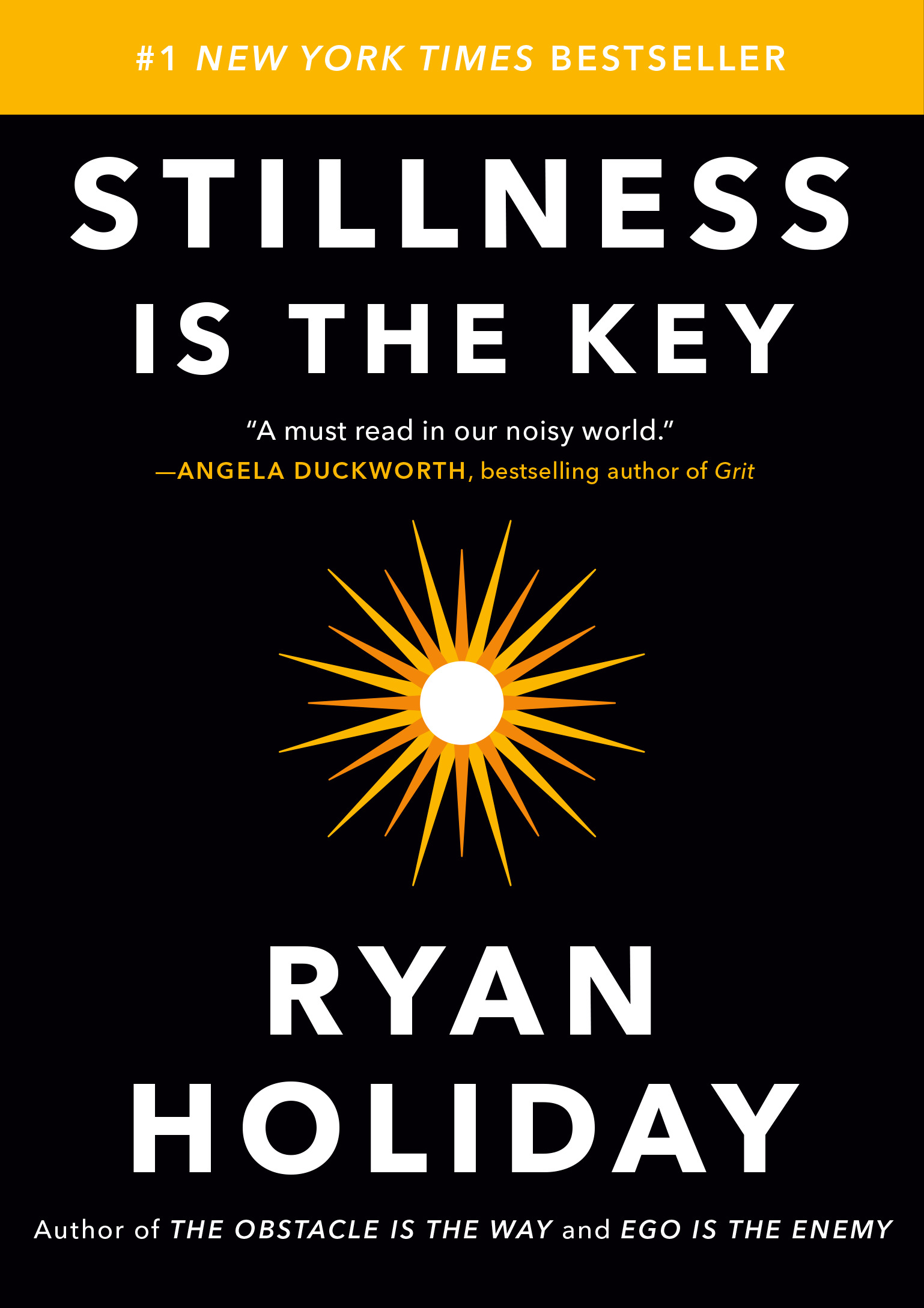
Stillness Is The Key by Ryan Holiday – book review

Stillness Is the Key

Overview

I recently came across the book by Ryan Holiday called “Stillness Is The Key”. I listened to this book via Audible, which took about 7 hours and is narrated by the author who does a very good job. The hardcover version of the book is 288 pages long, and can be acquired at Amazon for less than $15. I became interested in Ryan Holiday by watching some of his videos on YouTube, he has a channel called The Daily Stoic, so I thought I would check out this book. Actually he is a very popular author, media consultant, and entrepreneur appearing on many other people’s YouTube channels. He has several books that he has written and I will be reviewing another of his books in the near future.

If you are new to reading my book reviews, you will notice that I don’t provide lengthy descriptions of the content of the book. One of the reasons I do this is as not to spoil it for you, and another reason is that I am more interested in writing about what I perceive is the value of the book for the reader. You might also notice that almost every book I review on this site is one that I would recommend and that is because the name of this site is Inspirationalbookreviews.com not Wasteoftimebookreviews.com.

What I liked about this book

Everything!

Seriously this is a well written book citing very interesting stories about people like Tiger Woods, John F. Kennedy, and Mr. Fred Rogers, Winston Churchill just to name a few. Each chapter delves into a method for obtaining what he calls stillness, or maybe a sense of calm where rationale thinking can thrive. It also has a number of chapters that provide ideas on how you can enrich your life, but always returns to the theme of how to obtain stillness or in some cases how it was lost. There are also a lot of great quotes by the stoics such as Epictetus and Marcus Aurelius. This should be no surprise if you’ve watched any of his YouTube videos, as Ryan is a big fan of Stoicism. Here is a partial list of some of the chapters in the book:

  • Become Present
  • Limit Your Inputs
  • Slow Down, Think Deeply
  • Empty The Mind
  • Start Journaling
  • Choose Virtue
  • Enough

What I didn’t like about this book

Loved it all and I just wish it could have been 1,000 pages long.

Recommendation

Go out an buy it today! This is an excellent book that I intend to read or listen to again and again. In this busy world where we are all driving ourselves crazy, this book offers the antidote to chaos. This book isn’t some self help bullshit that is intended to fire you up and motivate you to do more with your life. In fact it is quite the opposite, offering insights on how to calm yourself, focus, play, and begin enjoying your life.


If you would like to support this blog, you can purchase the eBook (eBooks.com) version of this book at:

Stillness Is the Key

About the Author

Ryan Holiday (born June 16, 1987) is an American author, marketer, entrepreneur and founder of the creative advisory firm Brass Check. He is a media strategist, the former director of marketing for American Apparel and a media columnist and editor-at-large for the New York Observer.

Early career
Holiday began his professional career after dropping out of college at the age of 19. He briefly attended University of California, Riverside, where he studied political science and creative writing. He worked for Tucker Max, the controversial fratire author, to orchestrate a number of controversial media stunts including a boycott of Max’s work as part of a movie launch. Later, Holiday worked with Robert Greene, author of The 48 Laws of Power, on Greene’s 2009 New York Times bestselling book, The 50th Law. Holiday served as Director of Marketing for American Apparel and as an adviser to founder Dov Charney. He left the company in October 2014. He has been responsible for a number of media stunts, and written extensively on the topic of media manipulation.

Writing
Holiday is the author of several books and has written for Forbes, Fast Company, The Huffington Post, The Columbia Journalism Review, The Guardian, Thought Catalog, Medium.com and the New York Observer, where he is the media columnist.

In July 2012, his first book Trust Me, I’m Lying: Confessions of a Media Manipulator was released by Portfolio/Penguin. The book tries to expose flaws in current online journalism system and catalogs the author’s exploitation of them. It debuted on the Wall Street Journal bestseller list. His second book Growth Hacker Marketing was originally published in September 2013 by Portfolio/Penguin and then expanded into a print edition in 2014. The book shows how traditional marketing efforts (billboards, press releases) are no longer the most effective, and why growth hacking is cheaper and more effective in today’s market. The book was named one of Inc. Magazine’s top 10 marketing books of 2014.

In February 2014, Holiday was named editor-at-large of the Business & Technology section at the New York Observer.

Holiday’s third book The Obstacle Is The Way, was published May 1, 2014, also by Portfolio/Penguin. The book is based on the Stoic exercise of framing obstacles as opportunities. The book has sold more than 230,000 copies and was read by the New England Patriots during their 2014 Super Bowl-winning season, as well as distributed through the locker room of the Seattle Seahawks in the following offseason. The Obstacle Is the Way reached #1 on the Wall Street Journal Bestseller List in 2019, five years after its initial release. Two-time NBA Champion Chris Bosh listed The Obstacle Is the Way as his favorite book and added that, when his head coach Erik Spoelstra gifted Miami Heat players copies of the book, Bosh had already read it twice. During a press conference at the Masters in 2019, four-time major champion golfer Rory McIlroy said he read The Obstacle Is the Way as well as Holiday’s following book, Ego Is the Enemy, leading up to the tournament.

In 2016, he published two books. The first, Ego Is the Enemy, uses various historical figures as case studies to illustrate the perils of egotism. The second, The Daily Stoic, is a daily devotional of Stoic meditations. Both books went on to become best sellers with Daily Stoic reaching #3 overall on the bestseller list.

In 2018 he published Conspiracy: Peter Thiel, Hulk Hogan, Gawker, and the Anatomy of Intrigue. It is about the lawsuit between Gawker Media and wrestler Hulk Hogan, as well as Peter Thiel’s involvement in the dispute. It was favorably reviewed by William D. Cohan of the New York Times, who called the book, “one helluva page-turner.”

His latest book, Stillness Is the Key, was published in October 2019.

Stoicism
Holiday, through his books, articles and lectures, has been credited by the New York Times with the increasing popularity of stoicism. He was also described as “leading the charge for stoicism,” which has been noted for gaining traction among Silicon Valley entrepreneurs.


Atomic Habits by James Clear – book review

Atomic Habits

Atomic Habits is a book written by James Clear and as you might guess it is about ways to create habits. I happened to opt for the Audible version of this book, which by the way is narrated by the author. It’s not a terribly long read or even listening to it on Audible is less than 6 hours. The paperback version is 205 pages long and is $6 more expensive than the hardcover version on Amazon, which just doesn’t seem right.

What I liked about this book:

The premise behind the book is that the small (atomic) habits you adopt in your life have a major impact on your happiness and success in life. The author explores the psychology that underlies the adoption of a new habit and provides a number of proven approaches to adopting them. The author claims that it is not how long you have been working on a new habit, but instead the number of repetitions. An example would be say I want to take up playing guitar and once a week I practice playing guitar, so over the course of a month I would have put in 4 repetitions. Contrast this to practicing every day and over the course of two weeks I have practiced 14 times. Another interesting tip was to start very small or as the author says make it easy. With this method you would perform a new habit as little as 2 minutes. Now anyone can do a new habit for 2 minutes, but the psychology here is that it makes it easier to stick with it starting out with these small intervals. Anyone can run, practice guitar, workout with weights, keep a journal, or meditate for 2 minutes. What happens over time is you begin to extend that time period as you have already established a habit. Let’s say I go to the gym and start out doing 2 minutes of exercise, pretty soon you say well I took the time to get dressed and drive to the gym, maybe I can do more. The idea here is that I didn’t try to take a monumental leap from not working out to working out for an hour, and I will be less likely to quit before my workouts become a full fledged habit. There are many more techniques explored in this book that I won’t go into that will help you establish and stick with any new habits that you would like to adopt in your life.

What I didn’t like about this book:

While I was very interested in how to build new habits, I was also interested on how to get rid of some of my bad habits. While the author has a chapter on eliminating bad habits, much of that chapter is focused on creating good habits, so I didn’t get a lot of insights on how I might eliminate a bad habit. About all that was said is understand the negative ramifications of a bad habit and focus on the benefits of getting rid of it. Been there, done that!

Recommendation:

Overall I would give this book a thumbs up! There are so many good techniques for building a habit in this book that you are bound take something away from it that you can use yourself to create new habits. The author also goes into great detail on not only how to create a habit, but how to make it stick. One of the assertions the author makes is that it is much more important to learn to love the process or system that you are pursuing than just setting goals. While goals are great, they are not doing. It is more important to take action and fall in love with the idea of gaining some form of mastery than whatever the goal might be. The book did inspire me to pursue some new habits for myself which include:

If you would like to support this blog, you can purchase this book at:

eBooks.com

Atomic Habits

Audiobooks.com

Atomic Habits: Tiny Changes, Remarkable Results

About the Author James Clear:

Hi there, I’m James Clear. I’m an American author, entrepreneur, and photographer. I’m also the guy behind JamesClear.com (naturally).

This website is the home of my life’s work. I write about habits and human potential. The central question I’m trying to answer through my work is, “How can we live better?”

In order to answer that question, I uncover the latest scientific research and explain it in a way that you can easily understand and actually use. As I share these science-based ideas for living a better life, I like to showcase the habits and rituals of athletes, artists, and entrepreneurs. By analyzing the stories of top performers from many different fields and understanding proven scientific principles, we can start to tease out the common characteristics that make these people the best at what they do.

My specific focus is on self-improvement tips based on proven scientific research.

I believe the best way to change the world is in concentric circles: start with yourself and work your way out from there. If you get yourself sorted out, then that is one less person for the world to worry about. You’ll be in a position to contribute rather than consume. You will add order rather than disorder.

I write about the art and science of how to live better. Science because I am concerned with the root causes of our behavior and the data behind high performance. Art because I want to figure out how to apply these ideas and put them into daily practice.

But I don’t merely write about things. Along the way, I like to try out the concepts for myself as I experiment with building better habits as an entrepreneur, writer, and weightlifter. In the end, my work ends up being one-part storytelling, one-part academic research, one-part personal experiment. It’s a colorful blend of inspirational stories, academic science, hard-earned wisdom.

Source: https://jamesclear.com/about