Tag: writing

Post Office

About this book

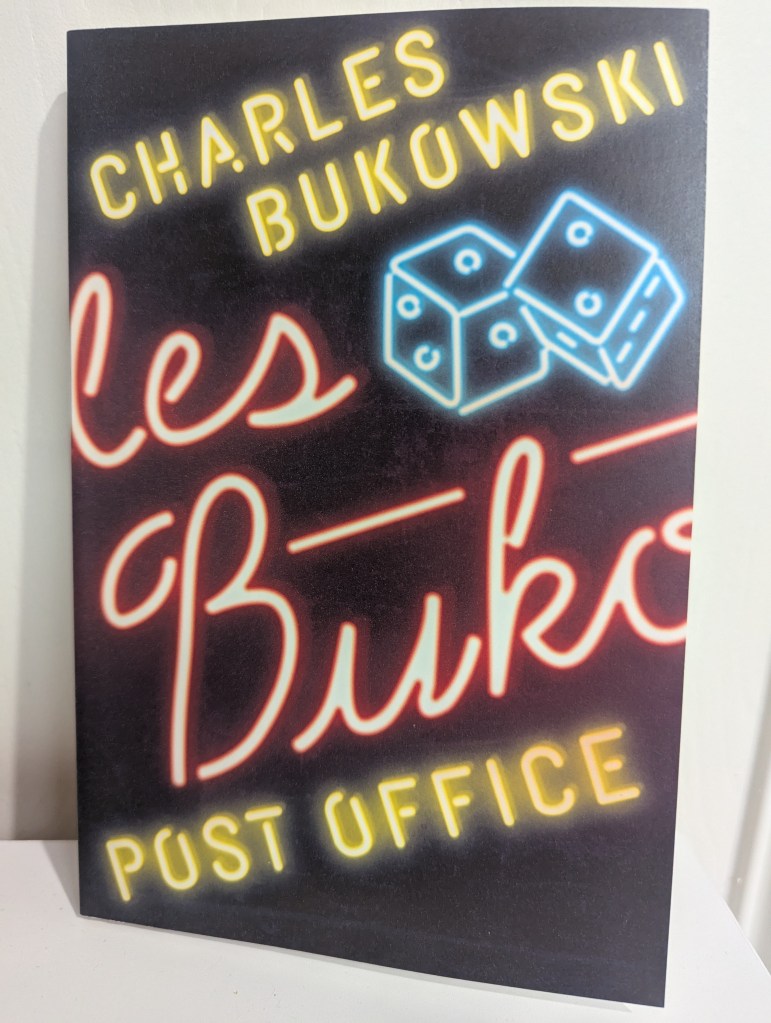
I recently read Post Office by Charles Bukowski, which was published in 1971. This is a relatively short book at 196 pages. I bought the paperback version from Thriftbooks, which has become my source for books during the past 4 months. The book is nicely bound and has a large font making it extremely easy to read for those of us that don’t have the best eyesight in the world. The quality of the pages are good and the book is 8″ high x 5 1/4″ wide, making it the ideal size to hold comfortably. I don’t recall what I paid for it, but it was less than $20 USD.

Summary

Post Office is a story about Henry Chinaski and his career with the United States Post Office. If you are unfamiliar with Charles Bukowski he worked in the post office for around 10 years, eventually quitting and becoming a fulltime writer. The book starts with a dedication “This is presented as a work of fiction and dedicated to nobody”, then the code of ethics for the post office is printed on what is really the first page of the book. The plot is about how Henry Chinaski started as a postal carrier and then as a clerk. The book is primarily about this miserable job, his interactions with supervisors and other workers, the women he had sex with, and of course drinking. I have read quite a bit about Charles Bukowski prior to reading Post Office and the details he writes about in this book could only have come from his own experiences, possibly embellished a bit, but the level of detail leads you to believe this book was a lot closer to an autobiography than fiction.

Throughout the book you realize the physical and mental struggle a Postal Carrier or Postal Clerk go through, and what a mind numbing experience it was. Of course these struggles were exasperated by all the late nights drinking and carousing with women that Chinaski participated in on a daily basis. One of the key themes in the book was the constant interactions with the supervisors and Chinaski’s disdain for them, which only got him in more trouble. Henry Chinaski was a crude character always drinking and chasing women, and if he wasn’t doing those things he was betting on horses.

Recommendation

I found this book very entertaining, actually laughing frequently while I was reading. If I have any advice I would spend some time reading about Charles Bukowski’s life before reading Post Office. It just helps to bring the whole thing into context as the character traits of Chinaski are pretty much the same as Bukowski and it makes reading Post Office much more fun. Lots of dialog between Chinaski and all the other characters, but all easy to follow. Understanding Bukowski and his attitude towards women and structure give you a better understanding of the time period and characters.

Ultimately this is also a novel about the plight of the working man and his complete hatred for the bureaucracy of the post office. I highly recommend it with the caveat I mentioned earlier regarding gaining some knowledge of the author first. I enjoyed it so much that I read it in a couple days. I’m looking forward to reading more from Mr. Bukowski who not only wrote novels, but was also well known for his poetry.

About the author

From Wikipedia:

Henry Charles Bukowski born Heinrich Karl Bukowski, August 16, 1920 – March 9, 1994) was a German-American poet, novelist, and short story writer. His writing was influenced by the social, cultural, and economic ambience of his adopted home city of Los Angeles. Bukowski’s work addresses the ordinary lives of poor Americans, the act of writing, alcohol, relationships with women, and the drudgery of work. The FBI kept a file on him as a result of his column Notes of a Dirty Old Man in the LA underground newspaper Open City.

Bukowski published extensively in small literary magazines and with small presses beginning in the early 1940s and continuing on through the early 1990s. He wrote thousands of poems, hundreds of short stories and six novels, eventually publishing over sixty books during the course of his career. Some of these works include his Poems Written Before Jumping Out of an 8 Story Window, published by his friend and fellow poet Charles Potts, and better-known works such as Burning in Water, Drowning in Flame. These poems and stories were later republished by John Martin’s Black Sparrow Press (now HarperCollins/Ecco Press) as collected volumes of his work. As noted by one reviewer, “Bukowski continued to be, thanks to his antics and deliberate clownish performances, the king of the underground and the epitome of the littles in the ensuing decades, stressing his loyalty to those small press editors who had first championed his work and consolidating his presence in new ventures such as the New York Quarterly, Chiron Review, or Slipstream.

References

https://en.wikipedia.org/wiki/Charles_Bukowski

This is a nice overview of Charles Bukowski https://www.poetryfoundation.org/poets/charles-bukowski
Brave New World

About this book

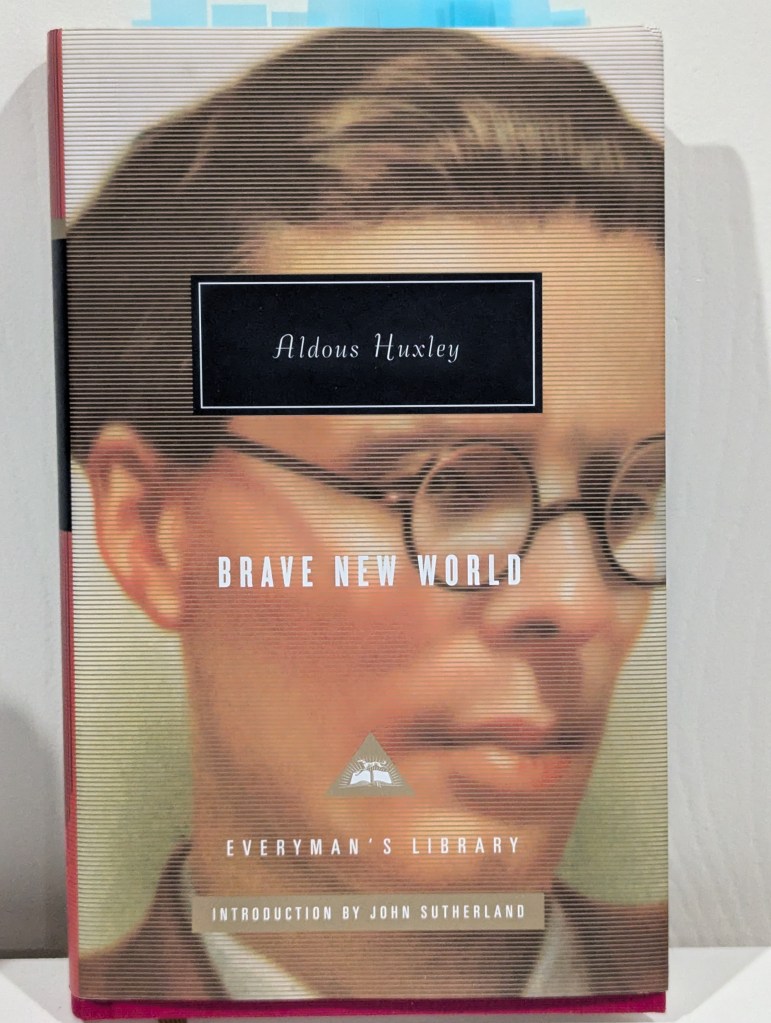
This book review is of Brave New World written by Aldous Huxley. Brave New World was published in 1932. I read a hard cover version of the book with dimensions 8 1/2″ high by 5 1/4 wide, which makes it comfortable to hold while reading. The book is 232 pages long, making it a fairly easy read in terms of time. The book has a nice Introduction that explains the premise of the book and some of the philosophy that Huxley borrowed from. What follows is a Notes section, Bibliography, and a Chronology of the life and events of the author, and then finally the chapters of the book. My hardcover version of the book is published by Everyman’s library in London, UK. The book has a nice cover, a relatively large font that is easy to read, high quality paper, and even includes a ribbon book mark. Overall this is a super nice, high quality book that makes a great collector item for your library.

Summary

If you read George Orwell’s 1984 you familiar with a society that was controlled by force and constant monitoring. Brave New World adopts a much different paradigm for controlling the population. In Huxley’s world the government uses eugenics to tightly control birth and create different classes of people. Aldous Huxley borrows many of his ideas about society from H. G. Wells, Bertrand Russel, J. B. Watson Behaviorism, and Vilfredo Pareto. From Pareto, a philosopher he uses General Sociology where the state is not run by dictators but by a management approach to society. From Watson he gets many of his ideas on what is referred to as conditioning. In Huxley’s Brave New World the masses are controlled by consumerism, conditioning, class, sexual promiscuity, and a drug called Soma. The people in this world are made so comfortable that they cease the desire for any form of personal expression and are rewarded by going along with the program.

In Brave New World there is no traditional family and as such no mother or father. In the first couple of chapters the book explains the process of how human beings are created and grown in test tubes in large factories. The government manipulates this process to produce different classes of people such as Alpha Plus, Alpha’s, Beta’s, and Epsilon’s. There may be other classes, but you get the idea. The higher level jobs in this society go to the Alpha Plus and Alpha’s, while what we might call factory worker jobs go to the Beta’s and Epsilon’s. This scientific breeding process is setup to create a particular class who’s numbers are created to fit the demand in the society.

I won’t go into the plot in any level of detail as that would spoil it for you, and I make an effort not to retell the story in all my reviews. Understand, that what we see from some of the primary characters is an awakening to the conditioning that this society has imposed upon them. The conditioning of the society happens as soon as the person is just a baby through repetition that teaches them that things that might inspire any sense of freedom are bad. In this society there are few books and the ones that exist are only those created by the state. Sensuality is a big theme of this society, with events that help to create lust in the public, encouraging multiple partners, and of course the appropriate birth control and hormone enhancement.

Unlike in Orwell’s 1984 those people that violate the society’s norms are not tortured, but instead attempts are made to reform them, and when that doesn’t work they are exiled. This removes the free thinkers from society, isolates them, and thus stability is maintained. A conscious effort was made to remove all traces of the past including museums and books published prior to a specific date. As the society that Huxley describes is based on consumerism the manufacture of goods and consumption becomes their religion if you will. Henry Ford has become a revered figure through what is called Fordism. When the populace has free time on their hands they are encouraged to consume Soma, which creates a high that lasts for hours and sometimes days depending on the dose. This creates a euphoria that masks any mental pain they may be experiencing and is a key component to keeping the people servile.

Overall in Brave New World we have a society without emotions, critical thinking skills, or even violence. A society that is in lock step to produce for the state and be easily managed. Reminds me of what we are progressing towards in the modern day Western world.

Recommendation

While I struggled with the first couple chapters, it was worth it as they built a foundation for understanding this dystopian society that Huxley writes about. I really enjoyed reading Brave New World and the ending is much as you might expect. This is not a book about the triumph of mankind over the machine, but really just the opposite. In this society science that leads to production and control over the populace is the goal, not science for the sake of discovery. It would not be too difficult to imagine our own society becoming this Brave New World. I would think Huxley was providing a warning for us, showing how easily we could be trapped into a world where pleasure is the primary goal along with the stability of the state at all costs. Highly recommended and a fairly quick read. Brave New World is a blueprint for controlling society using the carrot and not the stick.

About the Author

Aldous Leonard Huxley; 26 July 1894 – 22 November 1963) was an English writer and philosopher. His bibliography spans nearly 50 books, including non-fiction works, as well as essays, narratives, and poems.

Born into the prominent Huxley family, he graduated from Balliol College, Oxford, with a degree in English literature. Early in his career, he published short stories and poetry and edited the literary magazine Oxford Poetry, before going on to publish travel writing, satire, and screenplays. He spent the latter part of his life in the United States, living in Los Angeles from 1937 until his death. By the end of his life, Huxley was widely acknowledged as one of the foremost intellectuals of his time. He was nominated for the Nobel Prize in Literature nine times, and was elected Companion of Literature by the Royal Society of Literature in 1962.

References

About the Author – https://en.wikipedia.org/wiki/Aldous_Huxley

“Copyright 2025 InspirationalBookReviews.com. All Rights Reserved”

Please check out my companion blog thestoicbuddhist.com

I appreciate all comments and likes. Please follow my blog and you will be emailed notification of all new posts.

Namaste

Player Piano Kurt Vonnegut – book review

As you may be able to tell by now, I am quite a Kurt Vonnegut fan. I believe this is my third book review from Kurt Vonnegut. This was Kurt’s first novel published in 1952 and didn’t get much notice, which is a bit odd considering it is an excellent read or in my case listen on Audible. The narration is performed by Christian Rummel and it is incredible considering all the different characters that are included in this book. If you have read my book reviews before you know that I try not to spoil it for you focusing more on the themes and my own opinion of the work. If you want to know more about Kurt Vonnegut see the excerpt from Wikipedia below.

I swear Kurt Vonnegut could see into the future as the themes from this book have many parallels to what is happening today in terms of technology replacing many jobs that were formerly done by humans. The primary character is Dr. Paul Proteus the head of Engineering at the Ilium, New York plant. The premise of this novel shows the divide between the rich and the poor as machines take over the work formerly done by those they have displaced. There is also a lot of emphasis on blind corporate loyalty and competition for jobs by the elite who are paid 10 to 100’s times the salary of the common man, who by the way lives across the river over the bridge. I won’t go into how it all unfolds, but it all becomes very interesting. Some themes for me included:

  • Man vs. Machine
  • Rich vs. Poor
  • Educated vs. not Educated
  • Collective vs. Individualism
  • Blind Faith in Technology vs. Individual Expression
  • Planned Society vs. Capitalism / Free Enterprise
  • Relative comfort vs. Struggle

Recommendation

I flat out loved this book, the parallels with today are uncanny and the characters are incredibly complex in some ways and at the same time simply symbols of the themes mentioned above. You become emotionally attached to some of the characters such as Dr. Paul Proteus and appalled by others such as his wife Anita. While the battles expressed by the themes provide the opportunity for the author to provide a decisive conclusion to the questions posed in this book, the ending leaves the door open to debate, much like is the case today. If you like Kurt Vonnegut’s writing you will love this book, and if you haven’t had the chance to read or listen to his work, this is a great opportunity to begin where it all started.

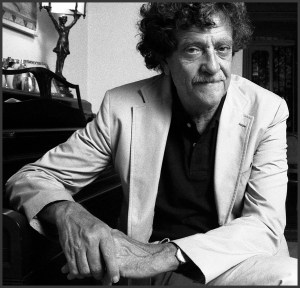
A picture of a middle age Kurt Vonnegut


If you would like to support this blog, please visit our Resources page where you can find lots of great products and services.


Wikipedia Excerpt

Kurt Vonnegut Jr. November 11, 1922 – April 11, 2007) was an American writer. In a career spanning over 50 years, Vonnegut published 14 novels, three short story collections, five plays, and five works of non-fiction, with further collections being published after his death. He is most famous for his darkly satirical, best-selling novel Slaughterhouse-Five (1969).

Born and raised in Indianapolis, Indiana, Vonnegut attended Cornell University but dropped out in January 1943 and enlisted in the United States Army. As part of his training, he studied mechanical engineering at Carnegie Institute of Technology (now Carnegie Mellon University) and the University of Tennessee. He was then deployed to Europe to fight in World War II and was captured by the Germans during the Battle of the Bulge. He was interned in Dresden and survived the Allied bombing of the city by taking refuge in a meat locker of the slaughterhouse where he was imprisoned. After the war, Vonnegut married Jane Marie Cox, with whom he had three children. He later adopted his sister’s three sons, after she died of cancer and her husband was killed in a train accident.

Vonnegut published his first novel, Player Piano, in 1952. The novel was reviewed positively but was not commercially successful. In the nearly 20 years that followed, Vonnegut published several novels that were only marginally successful, such as Cat’s Cradle (1963) and God Bless You, Mr. Rosewater (1964). Vonnegut’s breakthrough was his commercially and critically successful sixth novel, Slaughterhouse-Five. The book’s anti-war sentiment resonated with its readers amidst the ongoing Vietnam War and its reviews were generally positive. After its release, Slaughterhouse-Five went to the top of The New York Times Best Seller list, thrusting Vonnegut into fame. He was invited to give speeches, lectures and commencement addresses around the country and received many awards and honors.

Later in his career, Vonnegut published several autobiographical essays and short-story collections, including Fates Worse Than Death(1991), and A Man Without a Country (2005). After his death, he was hailed as a morbidly comical commentator on the society in which he lived and as one of the most important contemporary writers. Vonnegut’s son Mark published a compilation of his father’s unpublished compositions, titled Armageddon in Retrospect. In 2017, Seven Stories Press published Complete Stories, a collection of Vonnegut’s short fiction including 5 previously unpublished stories. Complete Stories was collected and introduced by Vonnegut friends and scholars Jerome Klinkowitz and Dan Wakefield. Numerous scholarly works have examined Vonnegut’s writing and humor.