Tag: practice

Food For The Heart

About this book

This review is of the book Food For The Heart written by Ajahn Chah. I bought the paperback version probably six months ago, where I paid less than $22.00 for the book (new). My introduction to this book actually was through an audio version on Audible, where I listened to the book maybe a dozen times. The Audible version is incredible, narrated by Graeme Malcolm who gives an incredible performance making the book so enjoyable to listen to. The audio book is about 15.5 hours long. The paperback is 396 pages long. The book has a nice binding and has a medium sized font making it easy to read. The quality of the pages are good and the book is 9″ high x 6″ wide, making it a fairly large book, but still one that you can hold comfortably. In addition to the chapters in the book there is an Introduction, Glossary, Notes, Sources for Text, and an Index.

Summary

Much like the Buddha the venerable Ajahn Chah was a master at adapting his teaching to his audience. Food For The Heart is a collection of his teachings “dhamma talks”. In this book Ajahn Chah one of the greatest teachers from Thailand covers conduct, meditation, the keys to liberation, and the various aspects of wisdom. Most of the content of this book are the teachings of Ajahn Chah and there is a conversational quality to the reading as if the master himself was talking to you or a small group. This conversational quality was of course one of the aspects that make this such a great audio book.

For those new to Buddhism or those just needing a refresher, the Introduction provides a basis for the rest of the book by covering the 4 Noble Truths, the Law of Kamma, Uncertainty, and the characteristics of Theravada teaching, which Ajahn Chah’s Thai Forest teachings are modeled after. The Introduction also covers Ajahn Chah’s life and teaching methods providing some context about the man for the rest of the book.

As you read Food For The Heart the resounding theme is the dharma is not found in books, but learned by experience. Much like Zen philosophy, Ajahn Chah emphasizes meditation as the key to practice. It is not that he feels books or dharma talks are useless, but they only facilitate or provide a conceptual framework. The true practice must be experienced with sitting and walking meditation. One of my favorite quotes from Ajahn Chah from this book is as follows:

The value of the Dhamma isn’t to be found in books. Those are just the external appearances of Dhamma; they’re not the realization of Dhamma as a personal experience. If you realize the Dhamma you realize your mind. You see the truth there. When the truth becomes apparent it cuts off the stream of delusion.

One of the other keys that Ajahn Chah repeatedly proclaims is the need to be diligent with your practice and this may include accepting some suffering to get through say a meditation session. He continuously urges you to devote yourself to your practice; to be disciplined and not give up when it becomes difficult. Of course he is correct, there is no point in reading or listening to the dharma without implementing these concepts in your life. Buddhism is not a spectators sport. Ajahn may be the coach, but to be on the team you need to play in the game and exert effort. Buddhism without effort is merely philosophy and while there is nothing wrong with a little philosophy it will not lead to the end of suffering and nibbana.

Recommendation

I won’t go into some long diatribe regarding why I love this book and strongly recommend it. One of the things I enjoyed was listening to or reading about a chapter everyday. This allowed me to think about the lesson / chapter and absorb what was being taught. Reading or listening to the book is very easy and enjoyable because of the straight forward English used; mostly due to the conversational style of the text.

I have read dozens of books on Buddhism over 20+ years, and I would rank Food For The Heart in my top 3 favorite books on Buddhism. The author Ajahn Chah was a brilliant teacher and gave his life to teaching the dhamma. One final thing regarding the format of the book. I love real paper based books, but in this case I just loved the audio version of this book. The narration was nothing short of excellent, but because the chapters are dharma talks and self contained you don’t need to consume it as if it was a story. This makes it nice to listen to and read when you have time.

About the Author

Normally I would provide you the Wikipedia link to information about an author, but I was able to find some nice sources on an Ajahn Chah website dedicated to the master.

I would recommend reading this short biography of Ajahn Chah located below as it comes from his website: https://www.ajahnchah.org/book/About_Ajahn_Chah.php

If you would like to know even more Ajahn Jayasaro speaks about the life of Ajahn Chah. Ajahn Jayasaro is an English disciple of Ajahn Chah, and the writer of Ajahn Chah’s biography in Thai language. https://www.ajahnchah.org/videos.htm

Additional Information

Notes: dharma and dhamma are the same thing “dhamma” is just the Pali spelling of dharma.

“Copyright 2025 InspirationalBookReviews.com. All Rights Reserved”

Please check out my companion blog thestoicbuddhist.com

I appreciate all comments and likes. Please follow my blog and you will be emailed notification of all new posts.

Namaste
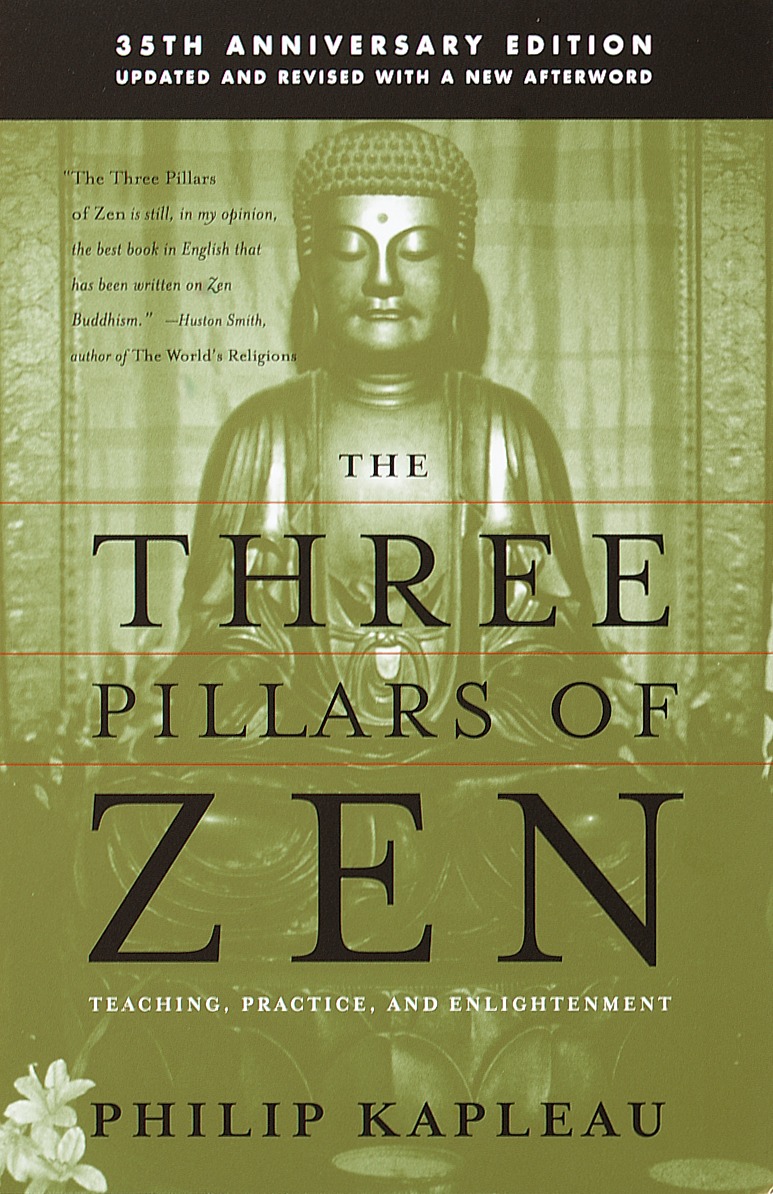
The Three Pillars of Zen – Philip Kapleau

The Three Pillars of Zen

Summary

It is a real joy to review the Three Pillars of Zen by Roshi Philip Kapleau. I have listened to this book on Audible several times and read a paperback version. The book is fairly long with the paperback being 441 pages and the audio version 14 hours and 27 minutes. The book covers in detail the practice of Zazen or what some might call meditation in great detail. While I am equating Zazen to meditation the author makes a distinction that Zazen is not traditional meditation. Roshi Philip Kaplan spent over 14 years in Japan studying Zen from the masters, most notably Yasutani Roshi. There is also a historical account of the great Dogen along with sources of information presented from both the Rinzai and Soto Zen disciplines perspectives. Much of this book is about the Yasautani Roshi’s encounters with Western students documented in painstaking detail by Roshi Philip Kapleau.

This book is not for the faint of heart as it seeks to express how Zen was practiced in the monasteries of Japan, going into details about the day to day life of a Roshi and Monks. Roshi Kaplan delves deep into the history of Zen and the goal of Zen Buddhism, which is Satori or enlightenment.

What I liked about this book

The incredible level of detail that went into capturing the sessions between students and Yasutani Roshi is truly astounding as it has never been done before. These interactions show the true value of a student having a Roshi and the wisdom of Yasutani Roshi. This elevates this book beyond that of just a lecture or philosophical discussion from an expert in Zen Buddhism to the exposure of true learning. Another thing that I really liked was the Afterword about how Zen has spread to the West, in particular, the United States and how it is practiced differently due to the differences in culture between East and West.

What was challenging about this book

There are a lot of dialogs here between the students and Yasutani Roshi, and it can be a chore to read, although it lends itself quite well to an audiobook format. The instruction on Zazen, that addresses so many aspects and even includes questions from students is a bit long-winded. It must be understood that Zen practitioners practice a form of meditation that is extremely exacting and it may not be everyone’s cup of tea, but I wouldn’t say that would stop anyone from appreciating it.

Recommendation:

If you have an interest in Zen Buddhism I highly recommend this book. While there have been many books written about Zen, this has to be in the top 5 and presents the most detailed accounts of Zen practice that I have ever read. Even if your interest isn’t exclusively in Zen Buddhism, but just in Buddhism, in general, I would read this book as there is so much that you can take away from it to enhance your own practice. I will give you an example, while I do not like some aspects of how Zazen is practiced, namely with eyes open (blurred or unfocused) and looking forward on the floor about 3 feet away. On the other hand, I heartedly agreed that the path to enlightenment is through practice, not theory, and this assertion was stressed throughout this wonderful book.

If you would like to support this blog, this book can be found at AudioBooks.com and eBooks.com. You can also check out my Resources page for lots of other great products.


Bestsellers at eBooks.com!

Body, Mind & Spirit eBooks


Get 2 AudioBooks Free and 720,000 Free Podcasts!


About the Author

source: https://en.wikipedia.org/wiki/Philip_Kapleau

Philip Kapleau (August 20, 1912 – May 6, 2004) was a teacher of Zen Buddhism in the Sanbo Kyodan tradition, a blending of Japanese Sōtō and Rinzai schools.

He trained initially with Soen Nakagawa, then rigorously with Daiun Harada at the temple Hosshin-ji. Later he became a disciple of Hakuun Yasutani, a dharma heir of Harada. After 13 years’ training, Kapleau was ordained by Yasutani in 1965 and given permission to teach. Kapleau ended his relationship with Yasutani formally in 1967 over disagreements about teaching and other personal issues. According to James Ishmael Ford, “Kapleau had completed about half of the Harada-Yasutani kōan curriculum, the koans in the Gateless Gate and the Blue Cliff Record,” and was entitled to teach, but did not receive dharma transmission. According to Andrew Rawlinson, “Kapleau has created his own Zen lineage.”

During a book tour in 1965 he was invited to teach meditation at a gathering in Rochester, New York[citation needed]. In 1966 he left Japan to create the Rochester Zen Center.

For almost 40 years, Kapleau taught at the Center and in many other settings around the world, and provided his own dharma transmission to several disciples. He also introduced many modifications to the Japanese Zen tradition, such as chanting the Heart Sutra in the local language, English in the U.S., or Polish at the Center he founded in Katowice. He often emphasized that Zen Buddhism adapted so readily to new cultures because it was not dependent upon a dogmatic external form. At the same time he recognized that it was not always easy to discern the form from the essence, and one had to be careful not to “throw the baby out with the bathwater.”

He suffered from Parkinson’s Disease for several years. While his physical mobility was reduced, he enjoyed lively and trenchant interactions with a steady stream of visitors throughout his life. On May 6, 2004, he died peacefully in the backyard of the Rochester Zen Center, surrounded by many of his closest disciples and friends.

Kapleau transcribed other Zen teachers’ talks, interviewed lay students and monks, and recorded the practical details of Zen Buddhist practice. His book, The Three Pillars of Zen, published in 1965, has been translated into 12 languages, and is still in print. It was one of the first English-language books to present Zen Buddhism not as philosophy, but as a pragmatic and salutary way of training and living. Michael Alan Singer, New York Times bestselling author and former CEO of WebMD, identified that the Three Pillars of Zen was the source which embarked him on his spiritual journey.

Kapleau was an articulate and passionate writer. His emphasis in writing and teaching was that insight and enlightenment are available to anyone, not just austere and isolated Zen monks. Also well known for his views on vegetarianism, peace and compassion, he remains widely read, and is a notable influence on Zen Buddhism as it is practiced in the West. Today, his dharma heirs and former students teach at Zen centers around the world.