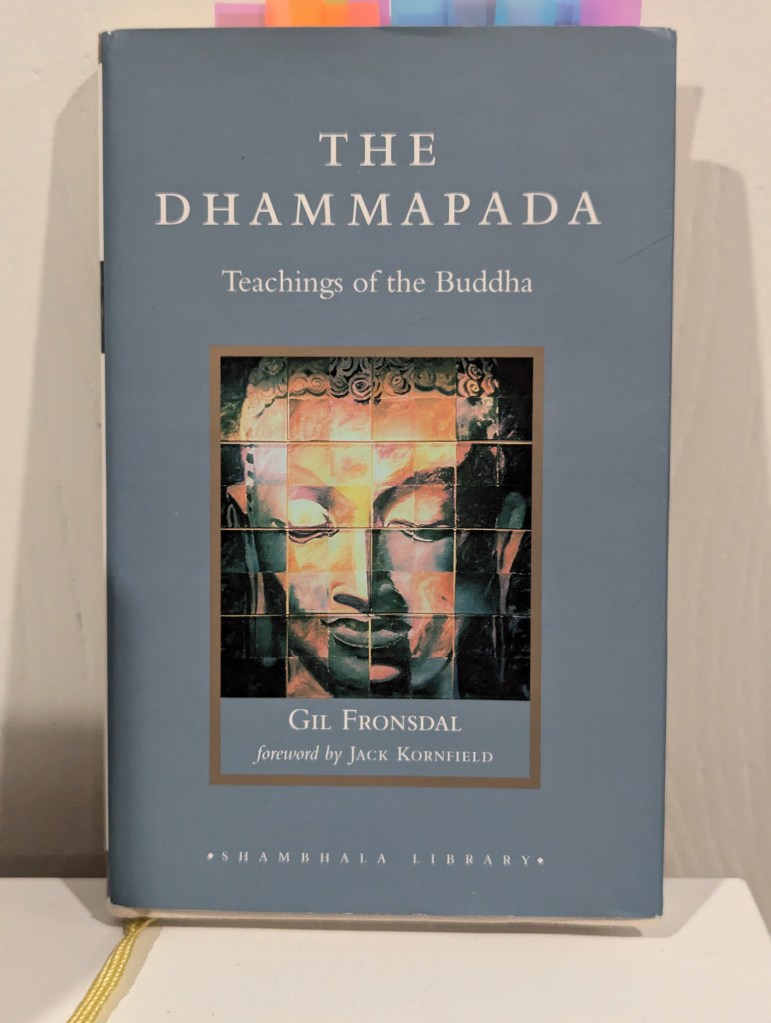
This book review is for one of the best-known seminal Buddhist verses, The Dhammapada – Teachings of the Buddha. The translation was written by Gil Fonsdal. I bought the hardcover version from ThriftBooks, where I paid $11.99 for the book (used). The hardcover version is 146 pages long. The book has a nice binding, cover, and has a medium-sized font, making it easy to read. The overall quality of the book is excellent. The book is 7″ high x 4 1/2″ wide, making it a book that you can hold comfortably. In addition to the 26 chapters in the book, there is a Foreword, Preface, Acknowledgments, Introduction, Bibliography, and an Appendix.
Summary
The Dhammapada is the most popular text for learning the path to liberation. It is the most widely read Buddhist scripture in existence. The Dhammapada is a collection of verses from the Pali Canon. This book is the translation of Pali into English. As the author of this translation points out, the Dhammapada has two goals:
To attain happiness in this life and future lives.
The second goal is liberation, meaning the perfection of the mind and the destruction of defilements, attachments, and hindrances.
The 26 chapters of the book explore various themes, including Vigilance, The Mind, The Sage, The Fool, Evil, Violence, The Buddha, and Happiness, among others. Each of these chapters is rather short, often two to four pages, and is comprised of verses. Note that each verse in the Dhammapada is numbered.
Let me share a couple select quotes from the Dhammapada:
Even while doing evil, fools are ignorant of it. Like someone burned by the fire, those lacking wisdom are scorched by their own deeds. (136)
Not disparaging others, not causing injury, practicing restraint by the monastic rules, knowing moderation in food, dwelling in solitude, and pursuing the higher states of mind, this is the teaching of the buddhas. (185)
Recommendation
As the Dhammapada is in a verse form and organized by themes, I liken it to the “Tao Te Ching” by Lao Tzu, which I have read many times. Wisdom permeates every page of the Dhammapada. You will find yourself pondering many of the verses as they permeate your mind and your understanding grows. This is not a book you read once, and in fact, reading a chapter each day in the morning can be a great way to start your practice off on the right foot. As you read it again and again, you will have new insights and reinforce the words of the Buddha, training your mind. Well, as you can see, I highly recommend picking up a copy; you won’t be disappointed.
Gil Fronsdal (born 1954) is a Norwegian-born, American Buddhist teacher, writer and scholar based in Redwood City, California. He has been practicing Buddhism of the Sōtō Zen and Vipassanā sects since 1975, and is currently teaching the practice of Buddhism in the San Francisco Bay Area. Having been taught by the Vipassanā practitioner Jack Kornfield, Fronsdal is part of the Vipassanā teachers’ collective at Spirit Rock Meditation Center. He was ordained as a Sōtō Zen priest at the San Francisco Zen Center in 1982, and was a Theravāda monk in Burma in 1985. In 1995, he received Dharma transmission from Mel Weitsman, the abbot of the Berkeley Zen Center.
He is the guiding teacher of the Insight Meditation Center (IMC) of Redwood City. He has a PhD in Buddhist Studies from Stanford University. His many dharma talks available online contain basic information on meditation and Buddhism, as well as subtle concepts of Buddhism explained at the level of the lay person.
This review is of the book Food For The Heart written by Ajahn Chah. I bought the paperback version probably six months ago, where I paid less than $22.00 for the book (new). My introduction to this book actually was through an audio version on Audible, where I listened to the book maybe a dozen times. The Audible version is incredible, narrated by Graeme Malcolm who gives an incredible performance making the book so enjoyable to listen to. The audio book is about 15.5 hours long. The paperback is 396 pages long. The book has a nice binding and has a medium sized font making it easy to read. The quality of the pages are good and the book is 9″ high x 6″ wide, making it a fairly large book, but still one that you can hold comfortably. In addition to the chapters in the book there is an Introduction, Glossary, Notes, Sources for Text, and an Index.
Summary
Much like the Buddha the venerable Ajahn Chah was a master at adapting his teaching to his audience. Food For The Heart is a collection of his teachings “dhamma talks”. In this book Ajahn Chah one of the greatest teachers from Thailand covers conduct, meditation, the keys to liberation, and the various aspects of wisdom. Most of the content of this book are the teachings of Ajahn Chah and there is a conversational quality to the reading as if the master himself was talking to you or a small group. This conversational quality was of course one of the aspects that make this such a great audio book.
For those new to Buddhism or those just needing a refresher, the Introduction provides a basis for the rest of the book by covering the 4 Noble Truths, the Law of Kamma, Uncertainty, and the characteristics of Theravada teaching, which Ajahn Chah’s Thai Forest teachings are modeled after. The Introduction also covers Ajahn Chah’s life and teaching methods providing some context about the man for the rest of the book.
As you read Food For The Heart the resounding theme is the dharma is not found in books, but learned by experience. Much like Zen philosophy, Ajahn Chah emphasizes meditation as the key to practice. It is not that he feels books or dharma talks are useless, but they only facilitate or provide a conceptual framework. The true practice must be experienced with sitting and walking meditation. One of my favorite quotes from Ajahn Chah from this book is as follows:
The value of the Dhamma isn’t to be found in books. Those are just the external appearances of Dhamma; they’re not the realization of Dhamma as a personal experience. If you realize the Dhamma you realize your mind. You see the truth there. When the truth becomes apparent it cuts off the stream of delusion.
One of the other keys that Ajahn Chah repeatedly proclaims is the need to be diligent with your practice and this may include accepting some suffering to get through say a meditation session. He continuously urges you to devote yourself to your practice; to be disciplined and not give up when it becomes difficult. Of course he is correct, there is no point in reading or listening to the dharma without implementing these concepts in your life. Buddhism is not a spectators sport. Ajahn may be the coach, but to be on the team you need to play in the game and exert effort. Buddhism without effort is merely philosophy and while there is nothing wrong with a little philosophy it will not lead to the end of suffering and nibbana.
Recommendation
I won’t go into some long diatribe regarding why I love this book and strongly recommend it. One of the things I enjoyed was listening to or reading about a chapter everyday. This allowed me to think about the lesson / chapter and absorb what was being taught. Reading or listening to the book is very easy and enjoyable because of the straight forward English used; mostly due to the conversational style of the text.
I have read dozens of books on Buddhism over 20+ years, and I would rank Food For The Heart in my top 3 favorite books on Buddhism. The author Ajahn Chah was a brilliant teacher and gave his life to teaching the dhamma. One final thing regarding the format of the book. I love real paper based books, but in this case I just loved the audio version of this book. The narration was nothing short of excellent, but because the chapters are dharma talks and self contained you don’t need to consume it as if it was a story. This makes it nice to listen to and read when you have time.
About the Author
Normally I would provide you the Wikipedia link to information about an author, but I was able to find some nice sources on an Ajahn Chah website dedicated to the master.
If you would like to know even more Ajahn Jayasaro speaks about the life of Ajahn Chah. Ajahn Jayasaro is an English disciple of Ajahn Chah, and the writer of Ajahn Chah’s biography in Thai language. https://www.ajahnchah.org/videos.htm
Additional Information
Notes: dharma and dhamma are the same thing “dhamma” is just the Pali spelling of dharma.
“Copyright 2025 InspirationalBookReviews.com. All Rights Reserved”
This is a book review of Henry David Thoreau’s Walden. I just finished reading Walden and wanted to provide a little information about the copy I read. It is a paperback book consisting of 242 pages, excellent type and page quality. The book is 9 inches high and 6 inches wide and for me, this is just about the right size because the font is easy to read and large enough for those of us without perfect eyesight. This is the complete edition with original illustrations. For a paperback, it is very high quality with substantial paper quality and a nice cover. Amazon has many versions of this book, but this one is still available and was less than $10 last time I checked. It always amazes me that such a notable work of literature is so cheap. I guess it is all about supply and demand.
Summary
This review will be significantly longer than most of my book reviews. It took me several months to complete reading this book, due to some degree that this is not a fast read. I’ll go into why later in my recommendation. Walden is a combination of philosophy and nature study, or maybe the intersection of the two disciplines.
There are 18 chapters in this book with most of them covering the 2 years and 2 months that Henry David Thoreau lived in a small cabin from July 4, 1845 – September 6, 1847, that he built near the shores of Walden Pond close to Concord Massachusetts. In the first chapter Thoreau outlines his philosophy regarding how man spends their time on this earth and the ramifications of this work on their lives. In the very first chapter “Economy” he outlines his philosophy regarding the plight of the working man. I will quote passages from the book that stood out to me to provide some insights into his philosophy.
“I have traveled a good deal in Concord: and everywhere, in shops, and offices, and fields, the inhabitants have appeared to me to be doing penance in a thousand remarkable ways.” (Economy p.5)
Then on the same page about his views regarding ownership, he states:
“I see young men, by townsmen, whose misfortune it is to have inherited farms, houses, barns, cattle, and farming tools; for these are more easily acquired than got rid of. Better if they had been born in the open pasture and suckled by a wolf, that they might have seen with clearer eyes that field they were called to labor in. Who made them serfs of the soil? Why should they eat their sixty acres, when man is condemned to eat only his peck of dirt? Why should they begin digging their graves as soon as they are born?” (Economy p.5)
Regarding the labor of men, Thoreau believed that their professions were so overwhelming that it left little time for leisure. “It is hard to have a southern overseer; it is worse to have a northern one; but worst of all when you are the slave-driver of yourself.” (Economy p. 7)
Going on to say “The mass of men lead lives of quiet desperation. What is called resignation is confirmed desperation.” (Economy p. 7)
Above all, Thoreau was what we would call a minimalist today and he viewed anything beyond food, clothing, and shelter as weighing man down, vying for the time he could be spending on more lofty pursuits.
Thoreau was also keenly aware of the inherent inequality of capitalism stating:
“The luxury of one class is counterbalanced by the indigence of another. On the one side is the palace, on the other are the almshouse and silent poor.” (Economy p. 27)
Much of the rest of the book is about building his cabin, and his keen observations regarding the seasons, neighbors, and geography at Walden Pond. These are so detailed as if written by a Naturalist. There is a passage in one of the chapters that goes into great detail about a war between two different species of ants. Thoreau also goes as far as to measure the depth of Walden Pond and other ponds in the area at different points in the bodies of water. Then there are the details of when Walden Pond froze in the Winter detailing the attributes of the ice such as the depth, color, and consistency.
It is obvious to the reader of this book that Thoreau had an immense curiosity and love for the nature that surrounded him.
Henry David Thoreau is often referred to as a Transcendentalist. There are many definitions of Transcendentalism, but I like the one that refers to an essay written by Ralph Waldo Emerson “The Transcendentalist”. From a very basic definition, we can think of Transcendentalism as:
Transcendentalism emphasized the importance of individualism, intuition, and a direct connection to the divine, and rejected the materialism and conformity of contemporary society. In “The Transcendentalist,” Emerson argues that Transcendentalists are people who seek to transcend the limitations of the physical world and find truth and meaning through spiritual and philosophical pursuits. He also notes that Transcendentalists embrace the power of the individual and reject the notion that authority should come from institutions or tradition.
Now you are subjected to my opinion of Walden by Henry David Thoreau. I mentioned earlier that there were times when reading Walden that I struggled due to an older form of prose with sometimes difficult to understand metaphors and long sentences. For me, the first couple of chapters “Economy” and “Where I lived, and What I Lived For” were the most difficult to comprehend. That said, this can be easily overcome by slowing down and carefully reading the text.
On the positive side, Walden is the kind of book you can relish each page while reading. So clear and explicit were the descriptions of nature that I often felt like I was there on Walden Pond experiencing nature myself. Thoreau calls us to experience a life of simplicity and investigation. As you read Walden you are likely to consider a life of minimalism, living off the grid if you will. From a philosophical perspective, Thoreau provides ample reasons for rejecting materialism, returning to nature, deep thought, and an appreciation of classical literature. I was so intrigued by his reference to the Illiad and Odyssey by Homer that I am reading the Illiad at the time of writing this book review.
I consider Walden as one of the great examples of classical American literature and highly recommend it. It is one of those books that will influence the way you think for the better. For me, it was tailor-made for the 20th or 21st Century audience. Walden is a breath of fresh air for the materialistic, capitalistic, me-oriented society that we live in today. The purpose of this blog has always been and will continue to be to review “inspirational books”, and Walden is a great example that you should consider adding to your library.
About the Author
Henry David Thoreau (July 12, 1817 – May 6, 1862) was an American naturalist, essayist, poet, and philosopher. A leading Transcendentalist, he is best known for his book Walden, a reflection upon simple living in natural surroundings, and his essay “Civil Disobedience” (originally published as “Resistance to Civil Government”), an argument in favor of citizen disobedience against an unjust state.
Thoreau’s books, articles, essays, journals, and poetry amount to more than 20 volumes. Among his lasting contributions are his writings on natural history and philosophy, in which he anticipated the methods and findings of ecology and environmental history, two sources of modern-day environmentalism. His literary style interweaves close observation of nature, personal experience, pointed rhetoric, symbolic meanings, and historical lore, while displaying a poetic sensibility, philosophical austerity, and attention to practical detail. He was also deeply interested in the idea of survival in the face of hostile elements, historical change, and natural decay; at the same time he advocated abandoning waste and illusion in order to discover life’s true essential needs.
Thoreau was a lifelong abolitionist, delivering lectures that attacked the fugitive slave law while praising the writings of Wendell Phillips and defending the abolitionist John Brown. Thoreau’s philosophy of civil disobedience later influenced the political thoughts and actions of notable figures such as Leo Tolstoy, Mahatma Gandhi, and Martin Luther King Jr.
Thoreau is sometimes referred to retrospectively as an anarchist, but may perhaps be more properly regarded as a proto-anarchist. In his seminal essay, “Civil Disobedience”, Thoreau wrote as follows:
“I heartily accept the motto,—’That government is best which governs least;’ and I should like to see it acted up to more rapidly and systematically. Carried out, it finally amounts to this, which also I believe,—’That government is best which governs not at all;’ and when men are prepared for it, that will be the kind of government which they will have…. But, to speak practically and as a citizen, unlike those who call themselves no-government men, I ask for, not at once no government, but at once a better government.”


 Inspirational Book Reviews