
Tag: work

Bullshit Jobs

Summary

I read this book a few months ago called Bullshit Jobs by David Graeber. What led me to read the book was most likely something I had seen on YouTube. Here is an example on YouTube of David Graeber explaining 5 types of Bullshit jobs:

The paperback book I read was almost 300 pages long without the Notes section at the end. The book was printed well with a font a little on the small size, maybe a 9 or 10 pitch, but readable. The author starts in the first chapter defining what a “Bullshit” job is.

Having worked in corporations for the vast majority of my life I had seen my own share of bullshit jobs up close and personal. The author goes on in subsequent chapters to elaborate on what kinds of jobs are bullshit jobs, why most people that have a bullshit job are unhappy, what it is like to have a bullshit job, and why are bullshit jobs proliferating. After you have a good understanding of what these bullshit jobs are the author in Chapter 6 and 7 goes into a decent amount of detail into what impact these jobs have on society.

There is also what the author calls the working definition of a bullshit job.

Provisional Definition: a bullshit job is a form of employment that is completely pointless, unnecessary, or pernicious that even the employee cannot justify its existence.

One of the things that Mr. Graeber elaborates on is the rise of the management role in industrialized capitalism. This of course created its own layer of bullshit jobs as management roles proliferated and left the actual producers (people doing the work) with almost zero autonomy.

Working Definition: a bullshit job is a form of paid employment that is so completely pointless, unnecessary, or pernicious that even the employee cannot justify its existence even though, as part of the conditions of employment, the employee feels obliged to pretend that this is not the case.

Of course bullshit jobs do not only exist in our capitalist enterprises. Academia has taken what used to be a Dean and the majority of employee’s at a university being faculty to what exists today more administrators than faculty.

What the hell?

Wonder why your tuition is so expensive?

Graeber also goes into detail on how these bullshit jobs invent processes that justify their existence such as multiple levels of approvals, pointless reports, and metrics with little to no meaning. Such is the surge in organizational bloat. So instead of donating the profits to charities, paying the real workers more, or investing into capital equipment, the modern goliath of a company builds additional layers and can’t understand why they are not more profitable and nimble.

Recommendation

I would recommend this book to most people that want to learn more about what is going on in corporate, government, and educational institutions. If you were starting a business you might look at this book as uncovering what you don’t want to do. For me it confirmed a lot of things I had thought for some time, but I also learned a lot about what these types of jobs do to the people that hold them.

The fact that we as a society are so utterly oblivious to the existence of these bullshit jobs is very telling. They say we are approaching a demographic tipping point, where in many countries we are not replacing the elderly with sufficient amounts of younger people to be consumers, drive growth, and work for our institutions. If this is so then maybe this will become the demise of bullshit jobs as we know it today.

Why is it we get so much satisfaction from accomplishing real work on the weekends, such as doing lawn work, building something? Is it because the work we do is often mundane and meaningless?

About the Author

David Rolfe Graeber; (February 12, 1961 – September 2, 2020) was an American anthropologist and anarchist activist. His influential work in economic anthropology, particularly his books Debt: The First 5,000 Years (2011), Bullshit Jobs (2018), and The Dawn of Everything (2021), and his leading role in the Occupy movement, earned him recognition as one of the foremost anthropologists and left-wing thinkers of his time.

Born in New York to a working-class Jewish family, Graeber studied at Purchase College and the University of Chicago, where he conducted ethnographic research in Madagascar under Marshall Sahlins and obtained his doctorate in 1996. He was an assistant professor at Yale University from 1998 to 2005, when the university controversially decided not to renew his contract before he was eligible for tenure. Unable to secure another position in the United States, he entered an “academic exile” in England, where he was a lecturer and reader at Goldsmiths’ College from 2008 to 2013, and a professor at the London School of Economics from 2013.

In his early scholarship, Graeber specialized in theories of value (Toward an Anthropological Theory of Value, 2002), social hierarchy and political power (Fragments of an Anarchist Anthropology, 2004, Possibilities, 2007, On Kings, 2017), and the ethnography of Madagascar (Lost People, 2007). In the 2010s he turned to historical anthropology, producing his best-known book, Debt: The First 5000 Years (2011), an exploration of the historical relationship between debt and social institutions, as well as a series of essays on the origins of social inequality in prehistory. In parallel, he developed critiques of bureaucracy and managerialism in contemporary capitalism, published in The Utopia of Rules (2015) and Bullshit Jobs (2018). He coined the concept of bullshit jobs in a 2013 essay that explored the proliferation of “paid employment that is so completely pointless, unnecessary, or pernicious that even the employee cannot justify its existence”.

Although exposed to radical left politics from a young age, Graeber’s direct involvement in activism began with the global justice movement of the 1990s. He attended protests against the 3rd Summit of the Americas in Quebec City in 2001 and the World Economic Forum in New York in 2002, and later wrote an ethnography of the movement, Direct Action (2009). In 2011, he became well known as one of the leading figures of Occupy Wall Street and is credited with coining the slogan “We are the 99%“. His later activism included interventions in support of the Rojava revolution in Syria, the British Labour Party under Jeremy Corbyn and Extinction Rebellion.

David Graeber died unexpectedly in September 2020, while on vacation in Venice. His last book, The Dawn of Everything: A New History of Humanity, co-written with archaeologist David Wengrow, was published posthumously in 2021.[5]

Reference: https://en.wikipedia.org/wiki/David_Graeber

Namaste

Let me know if you think you have a bullshit job.

Please check out my companion blog TheStoicBuddhist.com

Copyright 2023 InspirationalBookReviews.com. All Rights Reserved
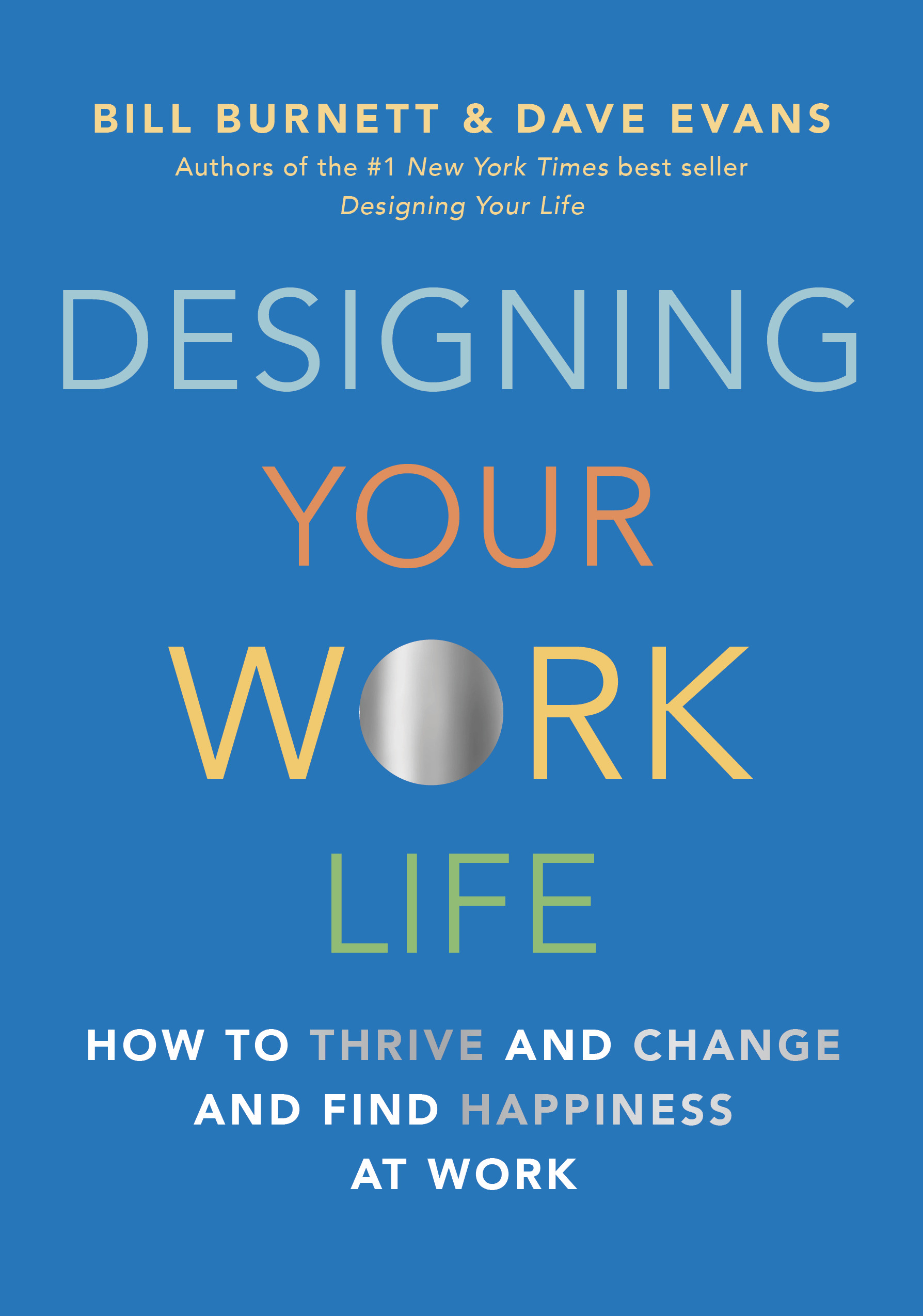
Designing Your Work Life

Designing Your Work Life

Summary

The book Designing Your Work Life was written by Bill Burnett and Dave Evans. Prior to reading this book the authors had written Designing Your Life, which I read, and it peaked my interest in reading this book. I have the hard cover version of the book and it is a great example of what a high quality book should look like. The print quality and font size are excellent.  Most of us struggle with our work from time to time, and our first instinct is to bail, you know get me the hell out of here. The authors provide some techniques on how you can salvage your current job by re-framing how you look at your work, and maybe more important empowering you to make changes to your job to make it more enjoyable. I’m actually looking at a list I created from the book called the Hydra Overwhelm List and Solutions, where I looked at things that were bothering me and sucking all the fun out of my job. In this list you write down the job activity that you have issues with, a possible solution, and whether you will eliminate that activity or change it. Mind you this is only one of the many tools and techniques they offer up that help you turn misery into something approaching joy at work.

In the event that you just can’t redesign your job, or you are in a situation where you work for a complete asshole, they also offer some excellent advise on how to quit the right way, and how to move on and find a new job. They even offer up some very good advice for those of us who might be interested in being self employed. The hardcover version of the book is 292 pages, so it’s not a terribly long read and each chapter is of reasonable length.


What I liked about this book

If you like aspects of your job, but hate or dislike some of the things you do, then this book may provide ways that you can not only salvage your current job, but redesign it into something you really enjoy. That alone is motivation to read this book if you are struggling on a day to day basis and losing sleep over your work. The authors come from a design background, so as in their previous book they utilize design practices to approach problems. One example of a design principle they use has to do with challenging your belief and then re-framing it. For instance you might re-frame like this:

Dysfunctional Belief: It’s not working for me here.

Re-frame as: You can make it work (almost) anywhere.


What did I dislike about this book

Seriously there is not a lot to dislike about the book. While the technique of re-framing will help you see things in a different light, there are times when that just won’t help you in a truly miserable situation. Your employer may vehemently resist your attempts to change your job to better fit your interests. Even with that said the authors understand that there are situations where invoking the exit strategy is the best thing for your piece of mind. The chapter on Being Your Own Boss is only 23 pages long, and while it has some useful information you will need to read and learn a lot of other things that are not covered in that chapter.


Recommendation

I highly recommend this book to those of you who struggle with various aspects of your work. I was able through my Hydra Overwhelm List, and some re-framing techniques to address most of the things that were causing the most pain, and ultimately find greater job satisfaction. I also found the authors advice on preparing to leave an employer and find a new job very valuable. One of the hopeful things that I got out of this book was that you have more control than you think, and some of the things you felt you had no control over were simply not true. On the other hand if you love your job, you may find the book offers little, but from the statistics I have read the majority of people are unengaged or actively disengaged at work. Here are some stats from a Gallop poll:

If your workforce is typical, about one-third of your employees are actively engaged, according to a recent Gallup poll. The poll found that nearly half, or 49 percent, are disengaged while 18 percent are actively disengaged. (Mar 17, 2016)


If you would like to support this blog, you can purchase the eBook (eBooks.com) version of this book at:

Designing Your Work Life

About the Authors

Bill Burnett
Executive Director of the Design Program at Stanford, Adjunct Professor, Mechanical Engineering, Stanford

After years of drawing cars and airplanes under his Grandmother’s sewing machine, Bill Burnett went off to the University and discovered, much to his surprise, that there were people in the world who did this kind of thing everyday (without the sewing machine) and they were called designers. Thirty years, five companies, and a couple of thousand students later Bill is still drawing and building things, teaching others how to do the same, and quietly enjoying the fact that no one has discovered that he is having too much fun.

Bill Burnett is the Executive Director of the Design Program at Stanford. He directs the undergraduate and graduate program in design at Stanford, both interdepartmental programs between the Mechanical Engineering department and the Art department. He got his BS and MS in Product Design at Stanford and has worked professionally on a wide variety of projects ranging from award-winning Apple PowerBooks to the original Hasbro Star Wars action figures. He holds a number of mechanical and design patents, and design awards for a variety of products including the first “slate” computer. In addition to his duties at Stanford, he is a on the Board of VOZ (pronounced “VAWS – it means voice in Spanish) a social responsible high fashion startup and advises several Internet start-up companies.

Dave Evans
Lecturer, Product Design Program at Stanford, Management Consultant, and co-founder of Electronic Arts

From saving the seals to solving the energy crisis, from imagining the first computer mice to redefining software — Dave’s been on a mission, including helping others to find theirs. Starting at Stanford with dreams of following Jacques Cousteau as a marine biologist, Dave realized (a bit late) that he was lousy at it and shifted to mechanical engineering with an eye on the energy problem. After four years in alternative energy, it was clear that this idea’s time hadn’t come yet. So while en route to biomedical engineering, Dave accepted an invitation to work for Apple, where he led product marketing for the mouse team and introduced laser printing to the masses. When Dave’s boss at Apple left to start Electronic Arts, Dave joined as the company’s first VP of Talent, dedicated to making “software worthy of the minds that use it.”

Having participated in forming the corporate cultures at Apple and EA, Dave decided his best work was in helping organizations build creative environments where people could do great work and love doing it. So he went out on his own; working with start-up teams, corporate executives, non-profit leaders, and countless young adults. They were all asking the same question. “What should I do with my life?” Helping people get traction on that question finally took Dave to Cal and Stanford and continues to be his life’s work.

Dave holds a BS and MS in Mechanical Engineering from Stanford and a graduate diploma in Contemplative Spirituality from San Francisco Theological Seminary.