Tag: literature

Island

About this book

This review is of the book Island, written by Aldous Huxley. Aldous Huxley’s novel Island was written and published in 1962. I bought the paperback version from ThriftBooks, where I paid $15.74 for the book (new). The paperback is 354 pages long. The book has a nice binding and has a medium-sized font, making it easy to read. The quality of the pages is good, and the book is 8″ high x 5 1/4″ wide, making it a book that you can hold comfortably. In addition to the 15 chapters in the book, there is an About the Author, About the Book, and a bibliography of all his works.

Summary

As with all my book reviews, I won’t bore you with a blow-by-blow review of the contents, as I feel that takes away the pleasure you may experience reading it. Instead, I will provide a brief synopsis of what the book is about and the value it brings to you, the reader. My hope is that I provide you enough information to understand at a high level the plot, some of the characters, and most importantly, how reading this book can benefit and create a level of enjoyment that reading an outstanding piece of literature provides.

I’ve written three other book reviews of Huxley’s work, including: Brave New World, Brave New World Revisited, and Ape and Essence. The reason I mention this is that Island was Huxley’s last novel, and there is some value in reading Brave New World, for instance, to understand the contrast between the dystopian world depicted in Brave New World and the near-perfect world described in Island.

The main character of the book was the highly disturbed but inquisitive Will Farnaby, an Englishman who became shipwrecked on the island of Pala and was discovered by the native people who lived on the island. Much of this book is about his experience learning about the island culture that can only be described as a utopia compared to Western culture. There are heavy overtones of Buddhism and Hinduism in the culture, with an emphasis on education, not for the sake of creating little capitalists, but focused on fostering an environment that facilitates the development of aware human beings and community. One might say the antithesis of the UK or the United States of America. The Palanese culture was the creation of a Doctor and Elder from the island. The elder is called the Raja, and in some contexts, this is like royalty in this culture. As in Brave New World there is a drug similar to Soma, but without the negative side effects, called moksha. While in Brave New World, Soma relieves pain and helps whoever uses it endure their lives, but moksha instead creates visions and is used to help one see the world for what it is.

As Will Farnaby learns more about the culture, he is made aware of a desire by an offspring of the Raja named Murigan, who is more interested in exploiting oil resources than preserving Pala’s culture. Will Farnaby has relationships with the oil industry and is supposed to facilitate a transaction with one of the oil companies, and he becomes torn between brokering a deal and preserving the culture he has been learning about. The question is, will this utopia be subverted by the capitalists, or will Pala’s culture survive?

Recommendation

Aldous Huxley appeared to have a fondness for Mahayana Buddhism, as it is featured as a cornerstone of Pala’s society and culture. What struck me the most was the eloquence and mastery of language that Aldous Huxley possesses. Having read three other novels by him, this was by far the very best of his writing that I have read so far. He builds a case for a society based on virtue, self-awareness, compassion, and community that does not exist in the world today. He is able to bring this Utopian society to life in this book. I slowly devoured this book one chapter at a time, much like any activity that you look forward to. If you are interested in reading something that shines a light on what an ideal society would look like, then Island is for you.

About the author

Aldous Leonard Huxley; 26 July 1894 – 22 November 1963) was an English writer and philosopher. His bibliography spans nearly 50 books, including non-fiction works, as well as essays, narratives, and poems.

Born into the prominent Huxley family, he graduated from Balliol College, Oxford, with a degree in English literature. Early in his career, he published short stories and poetry and edited the literary magazine Oxford Poetry, before going on to publish travel writing, satire, and screenplays. He spent the latter part of his life in the United States, living in Los Angeles from 1937 until his death. By the end of his life, Huxley was widely acknowledged as one of the foremost intellectuals of his time. He was nominated for the Nobel Prize in Literature nine times, and was elected Companion of Literature by the Royal Society of Literature in 1962.

Additional Information

About the Author – https://en.wikipedia.org/wiki/Aldous_Huxley

“Copyright 2025 InspirationalBookReviews.com. All Rights Reserved”

Please check out my companion blog thestoicbuddhist.com

I appreciate all comments and likes. Please follow my blog, and you will be emailed a notification of all new posts.

Namaste
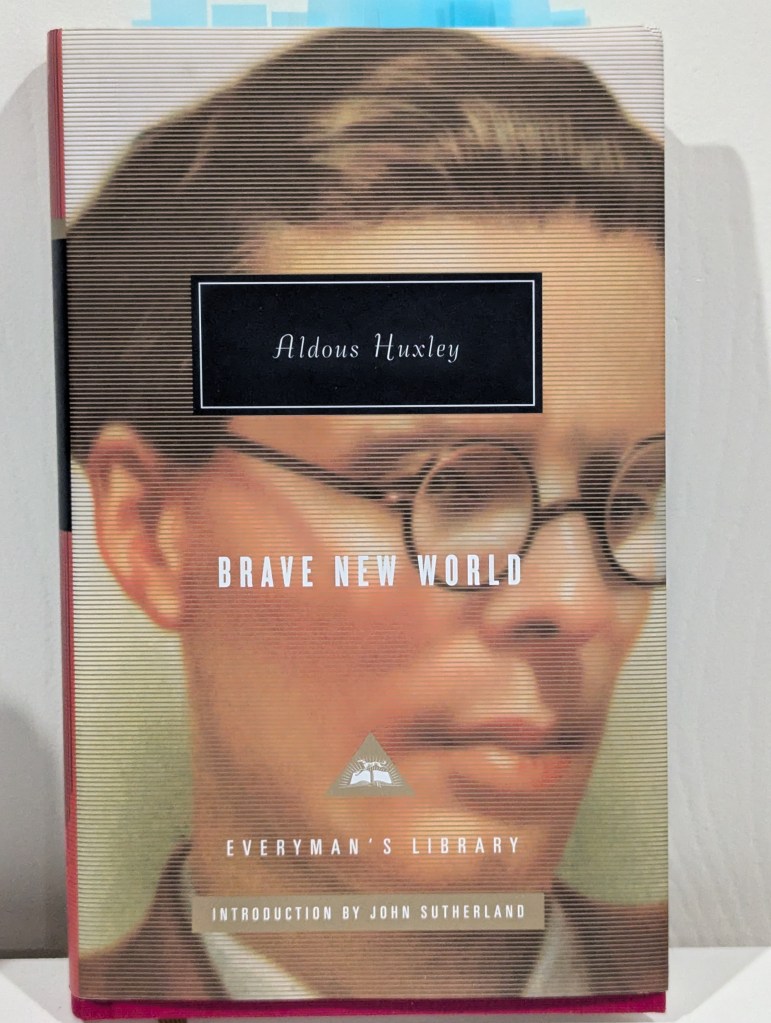
Brave New World

About this book

This book review is of Brave New World written by Aldous Huxley. Brave New World was published in 1932. I read a hard cover version of the book with dimensions 8 1/2″ high by 5 1/4 wide, which makes it comfortable to hold while reading. The book is 232 pages long, making it a fairly easy read in terms of time. The book has a nice Introduction that explains the premise of the book and some of the philosophy that Huxley borrowed from. What follows is a Notes section, Bibliography, and a Chronology of the life and events of the author, and then finally the chapters of the book. My hardcover version of the book is published by Everyman’s library in London, UK. The book has a nice cover, a relatively large font that is easy to read, high quality paper, and even includes a ribbon book mark. Overall this is a super nice, high quality book that makes a great collector item for your library.

Summary

If you read George Orwell’s 1984 you familiar with a society that was controlled by force and constant monitoring. Brave New World adopts a much different paradigm for controlling the population. In Huxley’s world the government uses eugenics to tightly control birth and create different classes of people. Aldous Huxley borrows many of his ideas about society from H. G. Wells, Bertrand Russel, J. B. Watson Behaviorism, and Vilfredo Pareto. From Pareto, a philosopher he uses General Sociology where the state is not run by dictators but by a management approach to society. From Watson he gets many of his ideas on what is referred to as conditioning. In Huxley’s Brave New World the masses are controlled by consumerism, conditioning, class, sexual promiscuity, and a drug called Soma. The people in this world are made so comfortable that they cease the desire for any form of personal expression and are rewarded by going along with the program.

In Brave New World there is no traditional family and as such no mother or father. In the first couple of chapters the book explains the process of how human beings are created and grown in test tubes in large factories. The government manipulates this process to produce different classes of people such as Alpha Plus, Alpha’s, Beta’s, and Epsilon’s. There may be other classes, but you get the idea. The higher level jobs in this society go to the Alpha Plus and Alpha’s, while what we might call factory worker jobs go to the Beta’s and Epsilon’s. This scientific breeding process is setup to create a particular class who’s numbers are created to fit the demand in the society.

I won’t go into the plot in any level of detail as that would spoil it for you, and I make an effort not to retell the story in all my reviews. Understand, that what we see from some of the primary characters is an awakening to the conditioning that this society has imposed upon them. The conditioning of the society happens as soon as the person is just a baby through repetition that teaches them that things that might inspire any sense of freedom are bad. In this society there are few books and the ones that exist are only those created by the state. Sensuality is a big theme of this society, with events that help to create lust in the public, encouraging multiple partners, and of course the appropriate birth control and hormone enhancement.

Unlike in Orwell’s 1984 those people that violate the society’s norms are not tortured, but instead attempts are made to reform them, and when that doesn’t work they are exiled. This removes the free thinkers from society, isolates them, and thus stability is maintained. A conscious effort was made to remove all traces of the past including museums and books published prior to a specific date. As the society that Huxley describes is based on consumerism the manufacture of goods and consumption becomes their religion if you will. Henry Ford has become a revered figure through what is called Fordism. When the populace has free time on their hands they are encouraged to consume Soma, which creates a high that lasts for hours and sometimes days depending on the dose. This creates a euphoria that masks any mental pain they may be experiencing and is a key component to keeping the people servile.

Overall in Brave New World we have a society without emotions, critical thinking skills, or even violence. A society that is in lock step to produce for the state and be easily managed. Reminds me of what we are progressing towards in the modern day Western world.

Recommendation

While I struggled with the first couple chapters, it was worth it as they built a foundation for understanding this dystopian society that Huxley writes about. I really enjoyed reading Brave New World and the ending is much as you might expect. This is not a book about the triumph of mankind over the machine, but really just the opposite. In this society science that leads to production and control over the populace is the goal, not science for the sake of discovery. It would not be too difficult to imagine our own society becoming this Brave New World. I would think Huxley was providing a warning for us, showing how easily we could be trapped into a world where pleasure is the primary goal along with the stability of the state at all costs. Highly recommended and a fairly quick read. Brave New World is a blueprint for controlling society using the carrot and not the stick.

About the Author

Aldous Leonard Huxley; 26 July 1894 – 22 November 1963) was an English writer and philosopher. His bibliography spans nearly 50 books, including non-fiction works, as well as essays, narratives, and poems.

Born into the prominent Huxley family, he graduated from Balliol College, Oxford, with a degree in English literature. Early in his career, he published short stories and poetry and edited the literary magazine Oxford Poetry, before going on to publish travel writing, satire, and screenplays. He spent the latter part of his life in the United States, living in Los Angeles from 1937 until his death. By the end of his life, Huxley was widely acknowledged as one of the foremost intellectuals of his time. He was nominated for the Nobel Prize in Literature nine times, and was elected Companion of Literature by the Royal Society of Literature in 1962.

References

About the Author – https://en.wikipedia.org/wiki/Aldous_Huxley

“Copyright 2025 InspirationalBookReviews.com. All Rights Reserved”

Please check out my companion blog thestoicbuddhist.com

I appreciate all comments and likes. Please follow my blog and you will be emailed notification of all new posts.

Namaste
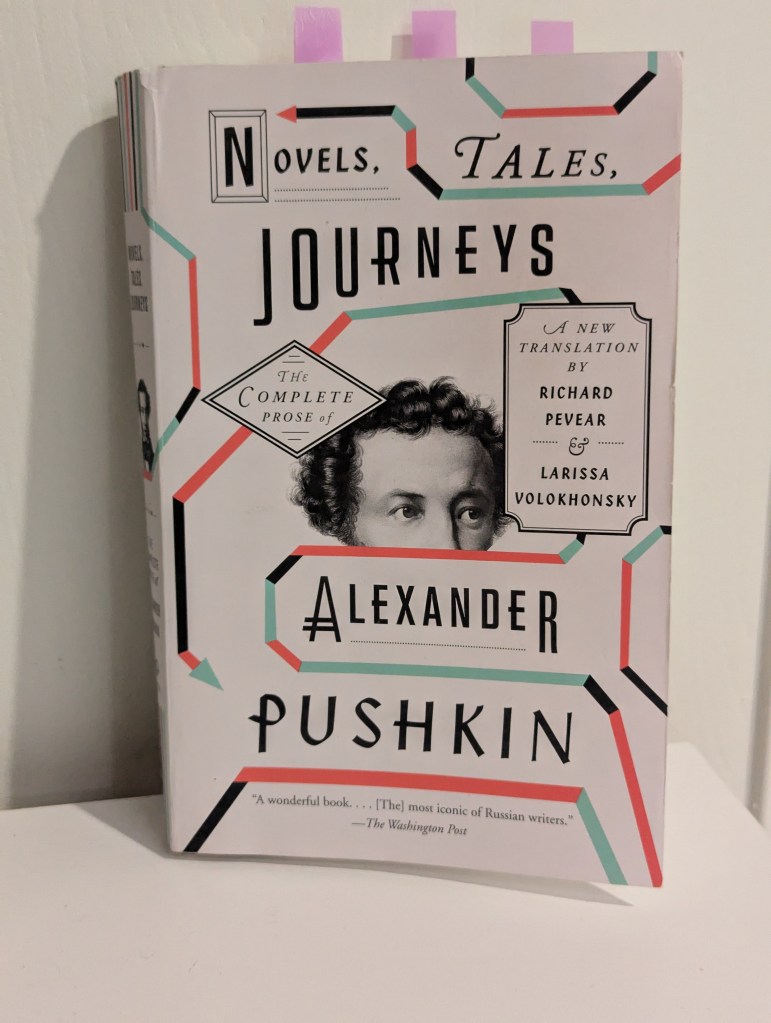
Novels, Tales, Journeys – Alexander Pushkin

About this book

The stories in Novels, Tales, Journeys were written by Alexander Pushkin translated by Richard Pevear and Larissa Volokhonsky. This book is the complete prose of Alexander Pushkin and as such it doesn’t include his poetry, but instead has a number of stories that he wrote. The book dimensions are 8″” high x 5 1/4″ wide and consists of some 484 pages. I have the paperback version, which is well constructed with nice cover and well printed pages. There is an Introduction, 10 stories, a section of Fragments and Sketches, and a Notes section.

Summary

As this is a collection of Pushkin’s prose I won’t be able to say there is a plot to this writing. I am a big fan of Russian writers having read all of Fyodor Dostoevsky’s novels and stories, Anton Chekhov’s stories, and a couple books by Aleksandr Solzhenitsyn. Pushkin proceeded all the authors I just mentioned, although there was some overlap with the life of Dostoevsky. One of the more interesting stories was called Dubrovsky, which was also one of the longer ones at 60 pages. The story of Dubrovsky had all the great elements including revenge, love, and intrigue. The Captains Daughter was another favorite for me and was over 100 pages, which makes it the longest story in the book. I also enjoyed The Queen of Spades a story about gambling and greed, one of Pushkin’s vices. As with reading Dostoevsky or Chekhov, you will be glancing back through the pages at times to determine who Pushkin is referencing. This has to do with the author referencing anyone of three names for a character or even abbreviated names. This may have slowed me down at times, but it was worth the effort. Even though I only mentioned these three stories all of the other stories are also very entertaining.

Recommendation

Pushkin is very skilled at describing the settings for the stories and the characters. His ability to pull you into the time period is outstanding. You feel like you are right there in early 19th century Russia with its nobility, serfs, terrible weather, alcohol addiction, military campaigns, and the ridiculous lack of medical science that accounted for the infant mortality and the short life span of the people. You also get a understanding of the ties between Russia and European countries especially France and Germany and the imprint it had on Russian society via art, literature, language, and fashion.

I read about half the book some time ago, and picked it up again starting over from the beginning. Reading about one story or part of the longer ones each day. It took me about two weeks to finish the book. I thoroughly enjoyed every page; looking forward to reading each day. If you are searching for a book that you can really enjoy and you have an interest in Russian literature then Novels, Tails, Journeys is a wonderful choice. Pushkin was in a league of his own and is still regarded as Russia’s greatest poet and story teller. In my own opinion I put him in the same class of Russian authors as Dostoevsky or Chekhov. Now with that said I have yet to tackle Tolstoy; more on that in the future.

About the author

Alexander Pushkin (1799 – 1837) dying at just 37 years old in a duel was a playwright, poet, and novelist who became prominent before he was 20 years old. He participated in some radical politics that had him banned from the Russian capital a couple times.

Pushkin was born into the Russian nobility in Moscow. His father, Sergey Lvovich Pushkin, belonged to an old noble family. One of his maternal great-grandfathers was Major-General Abram Petrovich Gannibal, a nobleman of African origin who was kidnapped from his homeland by the Ottomans, then freed by the Russian Emperor and raised in the Emperor’s court household as his godson.

He published his first poem at the age of 15, and was widely recognized by the literary establishment by the time of his graduation from the Tsarskoye Selo Lyceum. Upon graduation from the Lycée, Pushkin recited his controversial poem “Ode to Liberty”, one of several that led to his exile by Emperor Alexander I. While under strict surveillance by the Emperor’s political police and unable to publish, Pushkin wrote his most famous play, Boris Godunov. His novel in verse Eugene Onegin was serialized between 1825 and 1832. Pushkin was fatally wounded in a duel with his wife’s alleged lover and her sister’s husband, Georges-Charles de Heeckeren d’Anthès, also known as Dantes-Gekkern, a French officer serving with the Chevalier Guard Regiment.

Reference regarding the author: https://en.wikipedia.org/wiki/Alexander_Pushkin

“Copyright 2025 InspirationalBookReviews.com. All Rights Reserved”

Please check out my companion blog thestoicbuddhist.com

I appreciate all comments and likes. Please follow my blog and you will be emailed notification of all new posts.

Namaste
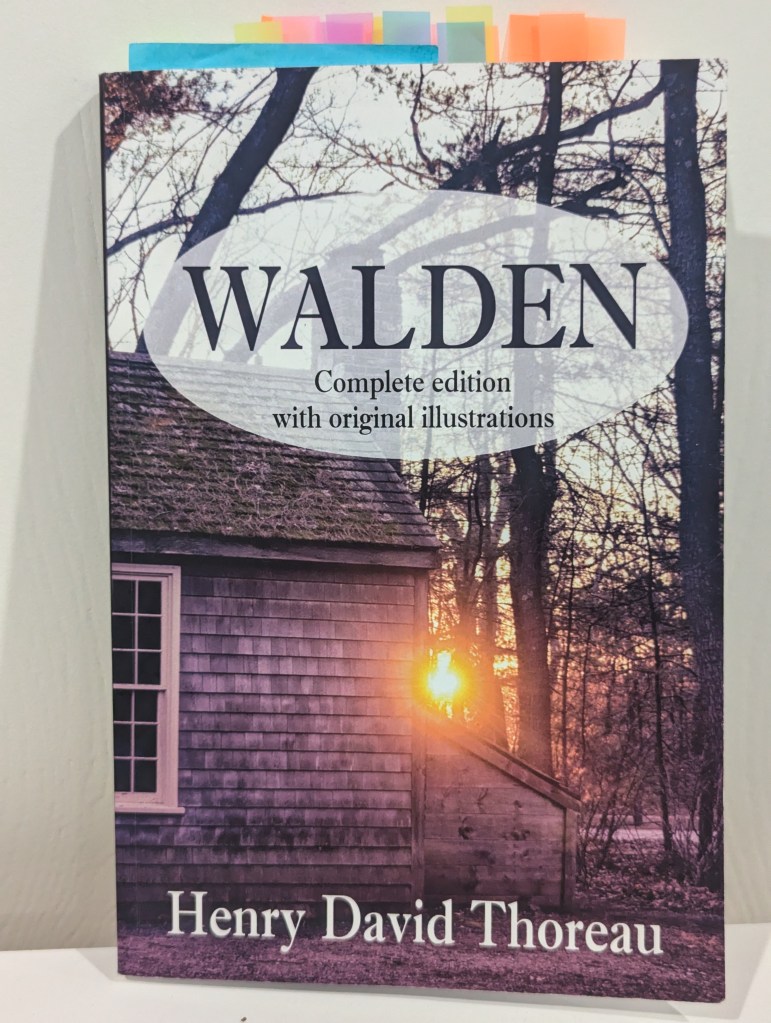
Walden

About this Book

This is a book review of Henry David Thoreau’s Walden. I just finished reading Walden and wanted to provide a little information about the copy I read. It is a paperback book consisting of 242 pages, excellent type and page quality. The book is 9 inches high and 6 inches wide and for me, this is just about the right size because the font is easy to read and large enough for those of us without perfect eyesight. This is the complete edition with original illustrations. For a paperback, it is very high quality with substantial paper quality and a nice cover. Amazon has many versions of this book, but this one is still available and was less than $10 last time I checked. It always amazes me that such a notable work of literature is so cheap. I guess it is all about supply and demand.

Summary

This review will be significantly longer than most of my book reviews. It took me several months to complete reading this book, due to some degree that this is not a fast read. I’ll go into why later in my recommendation. Walden is a combination of philosophy and nature study, or maybe the intersection of the two disciplines.

There are 18 chapters in this book with most of them covering the 2 years and 2 months that Henry David Thoreau lived in a small cabin from July 4, 1845 – September 6, 1847, that he built near the shores of Walden Pond close to Concord Massachusetts. In the first chapter Thoreau outlines his philosophy regarding how man spends their time on this earth and the ramifications of this work on their lives. In the very first chapter “Economy” he outlines his philosophy regarding the plight of the working man. I will quote passages from the book that stood out to me to provide some insights into his philosophy.

I have traveled a good deal in Concord: and everywhere, in shops, and offices, and fields, the inhabitants have appeared to me to be doing penance in a thousand remarkable ways.” (Economy p.5)

Then on the same page about his views regarding ownership, he states:

I see young men, by townsmen, whose misfortune it is to have inherited farms, houses, barns, cattle, and farming tools; for these are more easily acquired than got rid of. Better if they had been born in the open pasture and suckled by a wolf, that they might have seen with clearer eyes that field they were called to labor in. Who made them serfs of the soil? Why should they eat their sixty acres, when man is condemned to eat only his peck of dirt? Why should they begin digging their graves as soon as they are born?” (Economy p.5)

Regarding the labor of men, Thoreau believed that their professions were so overwhelming that it left little time for leisure. “It is hard to have a southern overseer; it is worse to have a northern one; but worst of all when you are the slave-driver of yourself.” (Economy p. 7)

Going on to say “The mass of men lead lives of quiet desperation. What is called resignation is confirmed desperation.” (Economy p. 7)

Above all, Thoreau was what we would call a minimalist today and he viewed anything beyond food, clothing, and shelter as weighing man down, vying for the time he could be spending on more lofty pursuits.

Thoreau was also keenly aware of the inherent inequality of capitalism stating:

The luxury of one class is counterbalanced by the indigence of another. On the one side is the palace, on the other are the almshouse and silent poor.” (Economy p. 27)

Much of the rest of the book is about building his cabin, and his keen observations regarding the seasons, neighbors, and geography at Walden Pond. These are so detailed as if written by a Naturalist. There is a passage in one of the chapters that goes into great detail about a war between two different species of ants. Thoreau also goes as far as to measure the depth of Walden Pond and other ponds in the area at different points in the bodies of water. Then there are the details of when Walden Pond froze in the Winter detailing the attributes of the ice such as the depth, color, and consistency.

It is obvious to the reader of this book that Thoreau had an immense curiosity and love for the nature that surrounded him.

Henry David Thoreau is often referred to as a Transcendentalist. There are many definitions of Transcendentalism, but I like the one that refers to an essay written by Ralph Waldo Emerson “The Transcendentalist”. From a very basic definition, we can think of Transcendentalism as:

Transcendentalism emphasized the importance of individualism, intuition, and a direct connection to the divine, and rejected the materialism and conformity of contemporary society. In “The Transcendentalist,” Emerson argues that Transcendentalists are people who seek to transcend the limitations of the physical world and find truth and meaning through spiritual and philosophical pursuits. He also notes that Transcendentalists embrace the power of the individual and reject the notion that authority should come from institutions or tradition.

Reference: https://emersoncentral.com/texts/nature-addresses-lectures/lectures/the-transcendentalist/

Recommendation

Now you are subjected to my opinion of Walden by Henry David Thoreau. I mentioned earlier that there were times when reading Walden that I struggled due to an older form of prose with sometimes difficult to understand metaphors and long sentences. For me, the first couple of chapters “Economy” and “Where I lived, and What I Lived For” were the most difficult to comprehend. That said, this can be easily overcome by slowing down and carefully reading the text.

On the positive side, Walden is the kind of book you can relish each page while reading. So clear and explicit were the descriptions of nature that I often felt like I was there on Walden Pond experiencing nature myself. Thoreau calls us to experience a life of simplicity and investigation. As you read Walden you are likely to consider a life of minimalism, living off the grid if you will. From a philosophical perspective, Thoreau provides ample reasons for rejecting materialism, returning to nature, deep thought, and an appreciation of classical literature. I was so intrigued by his reference to the Illiad and Odyssey by Homer that I am reading the Illiad at the time of writing this book review.

I consider Walden as one of the great examples of classical American literature and highly recommend it. It is one of those books that will influence the way you think for the better. For me, it was tailor-made for the 20th or 21st Century audience. Walden is a breath of fresh air for the materialistic, capitalistic, me-oriented society that we live in today. The purpose of this blog has always been and will continue to be to review “inspirational books”, and Walden is a great example that you should consider adding to your library.

About the Author

Henry David Thoreau (July 12, 1817 – May 6, 1862) was an American naturalist, essayist, poet, and philosopher. A leading Transcendentalist, he is best known for his book Walden, a reflection upon simple living in natural surroundings, and his essay “Civil Disobedience” (originally published as “Resistance to Civil Government”), an argument in favor of citizen disobedience against an unjust state.

Thoreau’s books, articles, essays, journals, and poetry amount to more than 20 volumes. Among his lasting contributions are his writings on natural history and philosophy, in which he anticipated the methods and findings of ecology and environmental history, two sources of modern-day environmentalism. His literary style interweaves close observation of nature, personal experience, pointed rhetoric, symbolic meanings, and historical lore, while displaying a poetic sensibility, philosophical austerity, and attention to practical detail. He was also deeply interested in the idea of survival in the face of hostile elements, historical change, and natural decay; at the same time he advocated abandoning waste and illusion in order to discover life’s true essential needs.

Thoreau was a lifelong abolitionist, delivering lectures that attacked the fugitive slave law while praising the writings of Wendell Phillips and defending the abolitionist John Brown. Thoreau’s philosophy of civil disobedience later influenced the political thoughts and actions of notable figures such as Leo Tolstoy, Mahatma Gandhi, and Martin Luther King Jr.

Thoreau is sometimes referred to retrospectively as an anarchist, but may perhaps be more properly regarded as a proto-anarchist. In his seminal essay, “Civil Disobedience”, Thoreau wrote as follows:

“I heartily accept the motto,—’That government is best which governs least;’ and I should like to see it acted up to more rapidly and systematically. Carried out, it finally amounts to this, which also I believe,—’That government is best which governs not at all;’ and when men are prepared for it, that will be the kind of government which they will have…. But, to speak practically and as a citizen, unlike those who call themselves no-government men, I ask for, not at once no government, but at once a better government.”

Reference: https://en.wikipedia.org/wiki/Henry_David_Thoreau

“Copyright 2024 InspirationalBookReviews.com. All Rights Reserved”

Please check out my companion blog thestoicbuddhist.com

I appreciate all comments and likes.

Please follow my blog and you will be emailed notification of all new posts.

Namaste