Summary
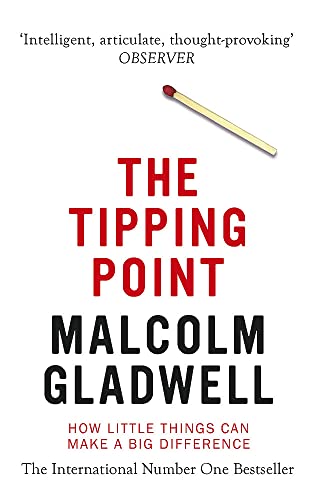
The Tipping Point by Malcom Gladwell it the 4th or 5th book I’ve read from this author. The book is only about 260 pages, quality printing and the font is decent size, making it easy to read for almost everyone. If you haven’t read Malcom Gladwell before, you are missing out. He has an easy to read writing style and I’ve found his books are very well researched.
Like all my other book reviews, I will summarize the primary themes in the book, but I don’t want to spoil it for you with a review that outlines all the chapters. Hopefully, I will provide enough information that helps you make a decision of whether you want to invest your time reading it. I will also provide my recommendation which consists mostly about why you might want to read this book. Finally I’ll provide some information about the author.
The Tipping Point is a book about how an idea, sometimes referred to as an epidemic tips or spreads, often very fast. There are three key roles that help to create the tipping point including Mavens, Connectors, and Salesmen. When an idea tips, a change has occurred in one or more of three areas:
- Law of the Few
- Stickiness Factor
- Power of Context
As I mentioned above a tipping point relies on the three roles mentioned above. A brief description of them would include:
- Connector – Connectors know lots of people and have a special gift for bringing the world together. “Sprinkled among every walk of life, in other words, are a handful of people with truly extraordinary knack of making friends and acquaintances. They are Connectors.” p. 41
- Maven – A Maven is one who accumulates knowledge. “These are the people who keep the marketplace honest. In the ten years or so since this group was first identified economists have gone to great lengths to understand them. They have found them in every walk of life and in every socioeconomic group. One name for them is price vigilantes. The other, more common, name for them is Market Mavens.” p. 61
- Salesmen – Salesman have the skills to persuade and are critical to creating word of mouth tipping points. They have enthusiasm, energy, and likeability that make them irresistible.
As I mentioned I won’t go into great detail reviewing this book, but the Power of Context was interesting to me in that a lot of ideas and tipping points thrive because of their environment. One of the examples was this that Gore Associates a privately held company in Delaware that makes Gore-Tex fabric, dental floss, and a number of specialty items has found an organizational construct that works for them. This contextual construct is called the Rule of 150. The Rule of 150 provides the guideline for the size of a group of people and any group greater than 150 people will suffer problems in communication, leadership, and the ability to innovate. Gore Associates takes this seriously and makes sure that their business can be sub divided with this number in mind, keeping plants smaller, and this allows more decision making and autonomy within this relatively smaller group of people. Having worked in very large groups sometimes in the thousands, it is not hard to understand how this would foster teamwork, communication, and just a better quality work life.
This whole book focuses on how epidemics are created, what was the tipping point and how the Law of the Few, Stickiness Factors, and the Power of Context factor into rapid change or tipping point.
Recommendation
I’ve read several other of Malcom Gladwell’s books including David and Goliath, Outliers, and Blink. While it is hard to dislike any of Mr. Gladwell’s books because he has a great writing style and as I mentioned before seems to do a lot of research to support his work. In this case it was a bit more difficult for me to enjoy the whole book. I often found myself speed reading some of the chapters to get to the next one, as I became somewhat bored by all the examples that were used to make a point. Here is the thing, if you are interested in how trends get started or why something may be a success from a commercial perspective then this is a good book for you. I think if you are in Marketing or Social Media or in some other profession where you want to persuade people then by all means read this book. It just wasn’t my cup of tea.
About the Author
English-born Canadian journalist, author, and speaker Malcolm Timothy Gladwell is known for his articles and books that identify, approach and explain the unexpected implications of social science research. In addition to his writing work, he is the podcast host of Revisionist History.
Early Life
Malcolm Gladwell was born on September 3, 1963, in Fareham, Hampshire, England to a father who was a mathematics professor, Graham Gladwell, and his mother Joyce Gladwell, a Jamaican psychotherapist. Gladwell grew up in Elmira, Ontario, Canada. He studied at the University of Toronto and received his bachelor’s degree in History in 1984 before moving to the U.S. to become a journalist. He initially covered business and science at the Washington Post where he worked for nine years. He began freelancing at The New Yorker before being offered a position as a staff writer there in 1996.
Malcolm Gladwell’s Literary Work
In 2000, Malcolm Gladwell took a phrase that had up until that point been most frequently associated with epidemiology and single-handedly realigned it in all of our minds as a social phenomenon. The phrase was “tipping point,” and Gladwell’s breakthrough pop-sociology book of the same name was about why and how some ideas spread like social epidemics. became a social epidemic itself and continues to be a bestseller.
Gladwell followed with Blink (2005), another book in which he examined a social phenomenon by dissecting numerous examples to arrive at his conclusions. Like The Tipping Point, Blink claimed a basis in research, but it was still written in a breezy and accessible voice that give Gladwell’s writing popular appeal. Blink is about the notion of rapid cognition — snap judgments and how and why people make them. The idea for the book came to Gladwell after he noticed that he was experiencing social repercussions as a result of growing out his afro (prior to that point, he had kept his hair close-cropped).
Both The Tipping Point and Blink were phenomenal bestsellers and his third book, Outliers (2008), took the same bestselling track. In Outliers, Gladwell once again synthesizes the experiences of numerous individuals in order to move beyond those experiences to arrive at a social phenomenon that others hadn’t noticed, or at least hadn’t popularized in the way that Gladwell has proved adept at doing. In compelling narrative form, Outliers examines the role that environment and cultural background play in the unfolding of great success stories.
Gladwell’s fourth book, What the Dog Saw: And Other Adventures (2009) gathers Gladwell’s favorite articles from The New Yorker from his time as a staff writer with the publication. The stories play with the common theme of perception as Gladwell tries to show the reader the world through the eyes of others – even if the point of view happens to be that of a dog.
His most recent publication, David and Goliath (2013), was inspired in part by an article that Gladwell penned for The New Yorker in 2009 called “How David Beats Goliath.” This fifth book from Gladwell focuses on the contrast of advantage and probability of success amongst the underdogs from varying situations, the most well-known story concerning the biblical David and Goliath. Although the book didn’t receive intense critical acclaim, it was a bestseller and hit No. 4 on The New York Times hardcover non-fiction chart, and No. 5 on USA Today‘s best-selling books.
Reference: https://www.thoughtco.com/profile-of-malcolm-gladwell-851807
Please check out my companion blog “TheStoicBuddhist.com“
“Copyright 2023 InspirationalBookReviews.com. All Rights Reserved”
 Inspirational Book Reviews