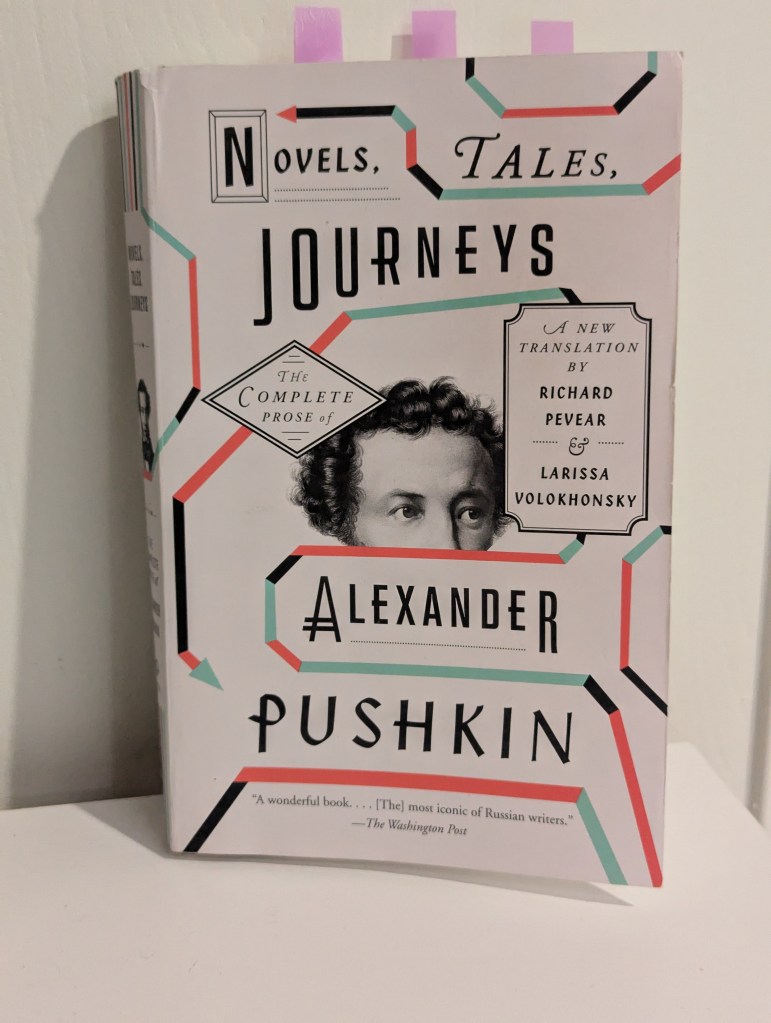
About this book
The stories in Novels, Tales, Journeys were written by Alexander Pushkin translated by Richard Pevear and Larissa Volokhonsky. This book is the complete prose of Alexander Pushkin and as such it doesn’t include his poetry, but instead has a number of stories that he wrote. The book dimensions are 8″” high x 5 1/4″ wide and consists of some 484 pages. I have the paperback version, which is well constructed with nice cover and well printed pages. There is an Introduction, 10 stories, a section of Fragments and Sketches, and a Notes section.
Summary
As this is a collection of Pushkin’s prose I won’t be able to say there is a plot to this writing. I am a big fan of Russian writers having read all of Fyodor Dostoevsky’s novels and stories, Anton Chekhov’s stories, and a couple books by Aleksandr Solzhenitsyn. Pushkin proceeded all the authors I just mentioned, although there was some overlap with the life of Dostoevsky. One of the more interesting stories was called Dubrovsky, which was also one of the longer ones at 60 pages. The story of Dubrovsky had all the great elements including revenge, love, and intrigue. The Captains Daughter was another favorite for me and was over 100 pages, which makes it the longest story in the book. I also enjoyed The Queen of Spades a story about gambling and greed, one of Pushkin’s vices. As with reading Dostoevsky or Chekhov, you will be glancing back through the pages at times to determine who Pushkin is referencing. This has to do with the author referencing anyone of three names for a character or even abbreviated names. This may have slowed me down at times, but it was worth the effort. Even though I only mentioned these three stories all of the other stories are also very entertaining.
Recommendation
Pushkin is very skilled at describing the settings for the stories and the characters. His ability to pull you into the time period is outstanding. You feel like you are right there in early 19th century Russia with its nobility, serfs, terrible weather, alcohol addiction, military campaigns, and the ridiculous lack of medical science that accounted for the infant mortality and the short life span of the people. You also get a understanding of the ties between Russia and European countries especially France and Germany and the imprint it had on Russian society via art, literature, language, and fashion.
I read about half the book some time ago, and picked it up again starting over from the beginning. Reading about one story or part of the longer ones each day. It took me about two weeks to finish the book. I thoroughly enjoyed every page; looking forward to reading each day. If you are searching for a book that you can really enjoy and you have an interest in Russian literature then Novels, Tails, Journeys is a wonderful choice. Pushkin was in a league of his own and is still regarded as Russia’s greatest poet and story teller. In my own opinion I put him in the same class of Russian authors as Dostoevsky or Chekhov. Now with that said I have yet to tackle Tolstoy; more on that in the future.
About the author
Alexander Pushkin (1799 – 1837) dying at just 37 years old in a duel was a playwright, poet, and novelist who became prominent before he was 20 years old. He participated in some radical politics that had him banned from the Russian capital a couple times.
Pushkin was born into the Russian nobility in Moscow. His father, Sergey Lvovich Pushkin, belonged to an old noble family. One of his maternal great-grandfathers was Major-General Abram Petrovich Gannibal, a nobleman of African origin who was kidnapped from his homeland by the Ottomans, then freed by the Russian Emperor and raised in the Emperor’s court household as his godson.
He published his first poem at the age of 15, and was widely recognized by the literary establishment by the time of his graduation from the Tsarskoye Selo Lyceum. Upon graduation from the Lycée, Pushkin recited his controversial poem “Ode to Liberty”, one of several that led to his exile by Emperor Alexander I. While under strict surveillance by the Emperor’s political police and unable to publish, Pushkin wrote his most famous play, Boris Godunov. His novel in verse Eugene Onegin was serialized between 1825 and 1832. Pushkin was fatally wounded in a duel with his wife’s alleged lover and her sister’s husband, Georges-Charles de Heeckeren d’Anthès, also known as Dantes-Gekkern, a French officer serving with the Chevalier Guard Regiment.
Reference regarding the author: https://en.wikipedia.org/wiki/Alexander_Pushkin
“Copyright 2025 InspirationalBookReviews.com. All Rights Reserved”
Please check out my companion blog thestoicbuddhist.com
I appreciate all comments and likes. Please follow my blog and you will be emailed notification of all new posts.
Namaste
 Inspirational Book Reviews