Tag: Aldous Huxley

Island

About this book

This review is of the book Island, written by Aldous Huxley. Aldous Huxley’s novel Island was written and published in 1962. I bought the paperback version from ThriftBooks, where I paid $15.74 for the book (new). The paperback is 354 pages long. The book has a nice binding and has a medium-sized font, making it easy to read. The quality of the pages is good, and the book is 8″ high x 5 1/4″ wide, making it a book that you can hold comfortably. In addition to the 15 chapters in the book, there is an About the Author, About the Book, and a bibliography of all his works.

Summary

As with all my book reviews, I won’t bore you with a blow-by-blow review of the contents, as I feel that takes away the pleasure you may experience reading it. Instead, I will provide a brief synopsis of what the book is about and the value it brings to you, the reader. My hope is that I provide you enough information to understand at a high level the plot, some of the characters, and most importantly, how reading this book can benefit and create a level of enjoyment that reading an outstanding piece of literature provides.

I’ve written three other book reviews of Huxley’s work, including: Brave New World, Brave New World Revisited, and Ape and Essence. The reason I mention this is that Island was Huxley’s last novel, and there is some value in reading Brave New World, for instance, to understand the contrast between the dystopian world depicted in Brave New World and the near-perfect world described in Island.

The main character of the book was the highly disturbed but inquisitive Will Farnaby, an Englishman who became shipwrecked on the island of Pala and was discovered by the native people who lived on the island. Much of this book is about his experience learning about the island culture that can only be described as a utopia compared to Western culture. There are heavy overtones of Buddhism and Hinduism in the culture, with an emphasis on education, not for the sake of creating little capitalists, but focused on fostering an environment that facilitates the development of aware human beings and community. One might say the antithesis of the UK or the United States of America. The Palanese culture was the creation of a Doctor and Elder from the island. The elder is called the Raja, and in some contexts, this is like royalty in this culture. As in Brave New World there is a drug similar to Soma, but without the negative side effects, called moksha. While in Brave New World, Soma relieves pain and helps whoever uses it endure their lives, but moksha instead creates visions and is used to help one see the world for what it is.

As Will Farnaby learns more about the culture, he is made aware of a desire by an offspring of the Raja named Murigan, who is more interested in exploiting oil resources than preserving Pala’s culture. Will Farnaby has relationships with the oil industry and is supposed to facilitate a transaction with one of the oil companies, and he becomes torn between brokering a deal and preserving the culture he has been learning about. The question is, will this utopia be subverted by the capitalists, or will Pala’s culture survive?

Recommendation

Aldous Huxley appeared to have a fondness for Mahayana Buddhism, as it is featured as a cornerstone of Pala’s society and culture. What struck me the most was the eloquence and mastery of language that Aldous Huxley possesses. Having read three other novels by him, this was by far the very best of his writing that I have read so far. He builds a case for a society based on virtue, self-awareness, compassion, and community that does not exist in the world today. He is able to bring this Utopian society to life in this book. I slowly devoured this book one chapter at a time, much like any activity that you look forward to. If you are interested in reading something that shines a light on what an ideal society would look like, then Island is for you.

About the author

Aldous Leonard Huxley; 26 July 1894 – 22 November 1963) was an English writer and philosopher. His bibliography spans nearly 50 books, including non-fiction works, as well as essays, narratives, and poems.

Born into the prominent Huxley family, he graduated from Balliol College, Oxford, with a degree in English literature. Early in his career, he published short stories and poetry and edited the literary magazine Oxford Poetry, before going on to publish travel writing, satire, and screenplays. He spent the latter part of his life in the United States, living in Los Angeles from 1937 until his death. By the end of his life, Huxley was widely acknowledged as one of the foremost intellectuals of his time. He was nominated for the Nobel Prize in Literature nine times, and was elected Companion of Literature by the Royal Society of Literature in 1962.

Additional Information

About the Author – https://en.wikipedia.org/wiki/Aldous_Huxley

“Copyright 2025 InspirationalBookReviews.com. All Rights Reserved”

Please check out my companion blog thestoicbuddhist.com

I appreciate all comments and likes. Please follow my blog, and you will be emailed a notification of all new posts.

Namaste
Ape and Essence

About this book

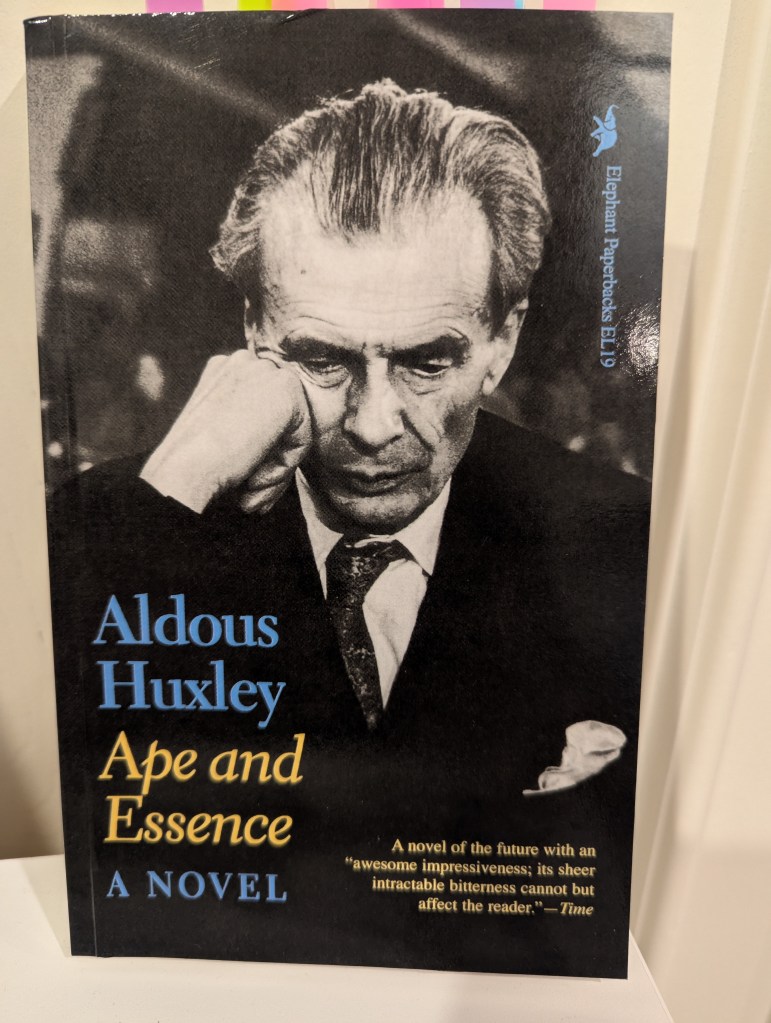
After reading Brave New World and Brave New World Revisited I ended up buying a couple other books by Aldous Huxley. This review is for the novel Ape and Essence. I bought the paperback version from Thriftbooks, where I paid $12.65 for the book (new). The book has a decent binding and has a large sized font making it easy to read. The quality of the pages are good and the book is 8″ high x 5″ wide, making it an easy size to hold comfortably. The book is divided into only two chapters (Tallis and The Script) and is 205 pages long. The book reads like a movie script where there is a scene that is described and a narrator. One of the things I found a little annoying was that the book title APE AND ESSENCE is printed at the top of each page, but pretty close to the text, and the page number has a similar proximity to the text being closer to the bottom of the page.

Summary

I provide the caveat for all my reviews that I will not get so detailed that I spoil your experience reading the book. So instead I will attempt to give you an overview of the plot, my thoughts about the book, and the benefit I received from reading it.

The vast majority of this book is presented as the script for a movie. The book starts when a couple writers who work at a movie studio find a bound movie script called “Ape and Essence” by William Tallis on the ground, where it was discarded. The discovery of the book and after reading some of the contents, the two men become curious and they go seek out the author. The author Tallis has passed away and that’s is where part two of the book begins. This second part of the book is the movie script for Ape and Essence. Now the society of the movie studio writers appears to be something analogous to the dystopian Brave New World, but that is not the focus of the book. The first chapter is 32 pages long and the 2nd chapter, which is really the remainder of the book starts on page 33 and ends on page 205.

The plot is about a New Zealand sailing vessel that ends up sailing and docking near Los Angeles, California. This journey by the New Zealanders comes at a post nuclear war scenario, where New Zealand was spared primarily because they were deemed insignificant. Dr. Poole one of the crew is captured and then is introduced to the people of this post apocalypse society. This post nuclear war society is made up of mostly scavengers and mutants from the radiation. The people of this post nuclear war world do not worship God, but instead worship Belial (Satan). I’m going to stop here before I give too much of it away.

Recommendation

I honestly considered putting this book down after reading the first chapter, but I’m glad I didn’t as I ended up finishing it just a few days after first picking it up, as I was engrossed in it. I think what spooked me at first was reading a book that was written like a movie script. Please don’t let that dissuade you from what turns out to be a very interesting book. This post nuclear war society is as you might imagine it would be somewhat savage, but like most societies it used mythology or religion as a way to align the populace around a way of life. There were some common themes around sexual activity, and the lack of love or commitment to individuals of the opposite sex just like in the society of Brave New World.

If you read Brave New World, the characters you will encounter in this book are much more grandiose and outrageous. Unlike Brave New World this post nuclear war world is also much more violent, and those living in this society are controlled by force. Huxley does a great job of putting you the reader right in the middle of this dystopian society and you often feel like you are seeing this world through the eyes of the captured New Zealander Dr. Poole. I feel that Huxley does a great job of depicting a somewhat savage society that one might expect would evolve from the post nuclear event. For me this was a real joy to read and further proof of Aldous Huxley’s story telling and forecasting what the future might look like in these circumstances.

About the Author

Wikipedia does a nice job providing information about the author. Here is snippet:

Aldous Leonard Huxley (26 July 1894 – 22 November 1963) was an English writer and philosopher. His bibliography spans nearly 50 books, including non-fiction works, as well as essays, narratives, and poems.

Born into the prominent Huxley family, he graduated from Balliol College, Oxford, with a degree in English literature. Early in his career, he published short stories and poetry and edited the literary magazine Oxford Poetry, before going on to publish travel writing, satire, and screenplays. He spent the latter part of his life in the United States, living in Los Angeles from 1937 until his death. By the end of his life, Huxley was widely acknowledged as one of the foremost intellectuals of his time. He was nominated for the Nobel Prize in Literature nine times, and was elected Companion of Literature by the Royal Society of Literature in 1962.

—————————————————————————————————-

“Copyright 2025 InspirationalBookReviews.com. All Rights Reserved”

Please check out my companion blog thestoicbuddhist.com

I appreciate all comments and likes. Please follow my blog and you will be emailed notification of all new posts.

Namaste
Brave New World Revisited

About this book

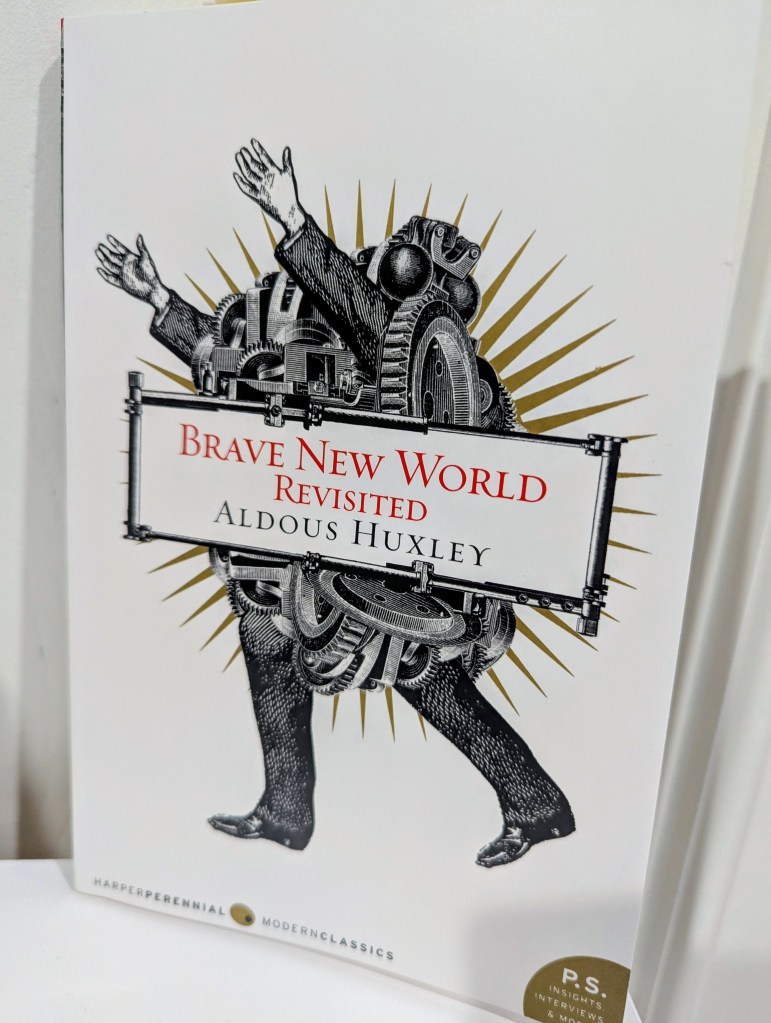
After reading Brave New World, I discovered Brave New World Revisited and after checking out a few reviews decided I needed to read it to understand Aldous Huxley’s thoughts about the world some 26 years after writing his original book. This is a relatively short book at 123 pages. I bought the paperback version from Thriftbooks, which has become my source for books during the past 5 months. The book is nicely bound and has a medium sized font making it easy to read. The quality of the pages are good and the book is 8″ high x 5 1/4″ wide, making it the ideal size to hold comfortably. I don’t recall what I paid for it, but it was less than $17 USD. The book has 12 chapters and most of them have only a few pages, which facilitates a book you can read a chapter and resume later. At the end of the book there is some pretty cool additions like About the Author, Some reviews and some of the authors own words about this book, a letter to George Orwell, and the complete Aldous Huxley bibliography.

Summary

There are so many interesting things about this book, but in my usual way I will try not to give you so much that its spoils your experience when reading the book. Remember, Brave New World was published in 1932 and Brave New World Revisited in 1958, so some 26 years had passed between the two books. Brave New World Revisited is a very philosophical look at the factors that exist or may exist that could make the dystopian society of Brave New World come true. One of the themes that Huxley mentions several times, is that he views the authoritarian regime of the future to be more like Brave New World than that of the brutal dictatorship of Orwell’s 1984.

I will outline a few of the factors that Huxley expounded on that could lead us to the authoritarian society:

Over-Population

At the time Huxley wrote Brave New World Revisited the population of the world was booming. He mentions that in 1931 when he was writing Brave New World the world’s population was a little less that 2 billion people and 27 years later it was 2.8 billion. People were beginning to live longer with new discoveries in agriculture and medicine were helping to spur on a larger population. His fear was that the population would get so large that the we could no longer support it with the resources we would have available. It was a valid assumption in 1958 and this theory was held by most people up until recent times, where we now are seeing declining birth rates. Huxley felt that over population to be one of the factors that would lead away from democracy to aristocracy. Remember at the time birth control pills were not yet available. Strangely enough he mentions that there would be 5.5 billion people by time his grand daughter was 50, so let’s say that was 2008. It turns out the world’s population in 2008 was about 6.7 billion.

Up until maybe the last 10 years or so, the fear of over population was a major concern, and still is in some parts of the world, but today we might not look at over population as a major driver of authoritarian regimes.

Quality of the Populace

One of the claims that Huxley makes is over the past few decades there has been an overall decline in IQ and health of the population. Some of this has been caused by advances in medicine, where in the past people may have died, but now were able to propagate their genes on to the next generation. His concern here also goes back to a declining death rates adding to overall population. If in fact IQ has been declining over the decades for various reasons, does this bode well for a flourishing democracy? This may sound confusing, but think about it as kind of an anti eugenics scenario brought about by a weaker gene pool surviving due to advances in medicine.

Over Organization

Under this title of over organization Huxley discusses his growing concern that technology would result in power being consolidated in fewer and fewer hands. His concern is that small business would be squeezed out by large multi-national corporations and wealth would belong to a few oligarchs that had near monopolies. Can you say Amazon, Tesla, Meta, Google? He wrote this around 1957 and it rings true today in 2025. These large, near monopolies have also created super organized companies. Huxley’s fear was this would create people that were more like robots and lacked creative thinking, and any appreciation for freedom, making them easy marks for authoritarianism.

Additional Drivers

In addition to the factors of over population, quality of the people, and over organization Huxley provides the details on how the would be autocrats use propaganda, salesmanship, brainwashing, and even chemical persuasion to stamp out democracy.

When you look at all the factors cited in Brave New World Revisited it is almost a playbook for the would be autocrat or dictator. One of the scary points that Huxley makes, is that we have a certain percentage of the population that is very responsive to outside suggestion. These people will make it almost impossible to support a democracy or even foster the environment for one to form. Now we look ahead from 1958 when Huxley provided his analysis and forecast for the future to today, in 2025. It appears that this relatively small slice of the population that is extremely suggestible has grown to be anywhere from 25-30% of the US population.

I usually avoid politics in most of my writing, but the Trump Administration and (MAGA) Make America Great Again movement is moving quickly down the authoritarian road. I can tell you that they haven’t read Brave New World as their methods are somewhat crude, often in your face, and are not very clever. This doesn’t fool the populace as much as it enrages it.

Recommendation

If you enjoyed reading Brave New World you will find it quite natural to read Brave New World Revisited. In the 26 or 27 years that passed between each of these books the world changed considerably, which gave Huxley some insight into what the future might hold. Aldous Huxley had an eerie sense of how the world would change in the future and as you read this book you will see just how spot on he was when you compare his forecasts to the world today. When you read Aldous Huxley’s books you are struck with just how intelligent he was. Truly an amazing individual, part story teller and part philosopher. I highly recommend Brave New World Revisited. Of course with the caveat that you read Brave New World first.

This won’t be the last book I review written by Aldous Huxley, so stay tuned.

About the Author

Wikipedia does a nice job providing information about the author. Here is snippet:

Aldous Leonard Huxley (26 July 1894 – 22 November 1963) was an English writer and philosopher. His bibliography spans nearly 50 books, including non-fiction works, as well as essays, narratives, and poems.

Born into the prominent Huxley family, he graduated from Balliol College, Oxford, with a degree in English literature. Early in his career, he published short stories and poetry and edited the literary magazine Oxford Poetry, before going on to publish travel writing, satire, and screenplays. He spent the latter part of his life in the United States, living in Los Angeles from 1937 until his death. By the end of his life, Huxley was widely acknowledged as one of the foremost intellectuals of his time. He was nominated for the Nobel Prize in Literature nine times,[9] and was elected Companion of Literature by the Royal Society of Literature in 1962.

https://en.wikipedia.org/wiki/Aldous_Huxley

—————————————————————————————————-

“Copyright 2025 InspirationalBookReviews.com. All Rights Reserved”

Please check out my companion blog thestoicbuddhist.com

I appreciate all comments and likes. Please follow my blog and you will be emailed notification of all new posts.

Namaste
Brave New World

About this book

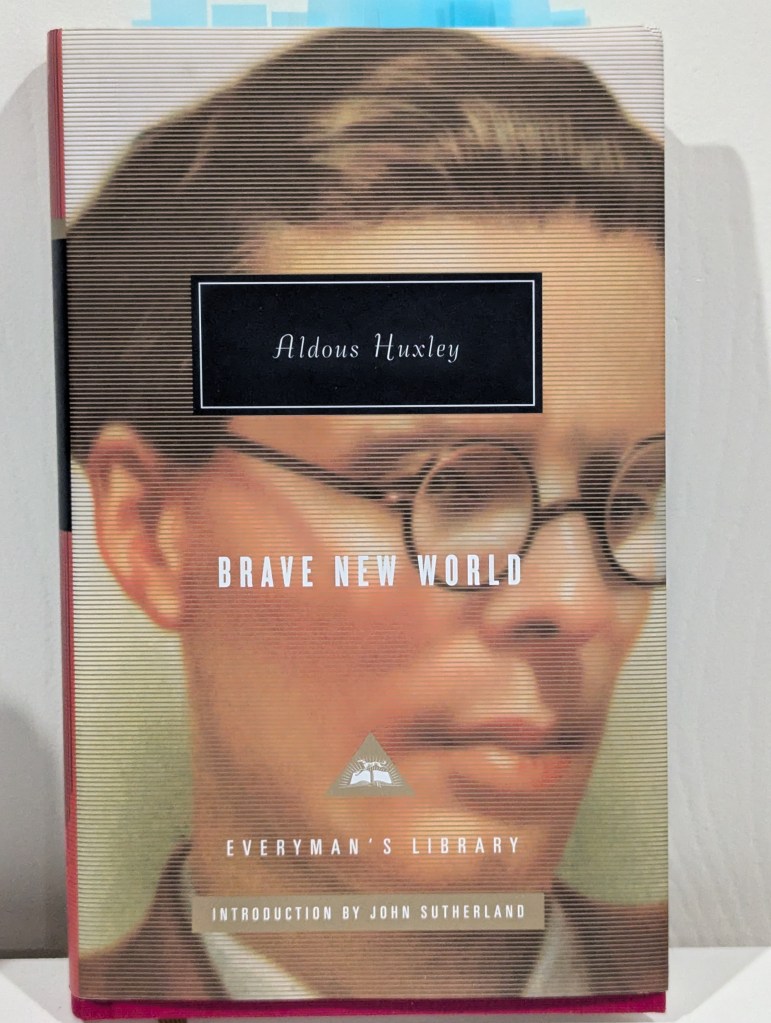
This book review is of Brave New World written by Aldous Huxley. Brave New World was published in 1932. I read a hard cover version of the book with dimensions 8 1/2″ high by 5 1/4 wide, which makes it comfortable to hold while reading. The book is 232 pages long, making it a fairly easy read in terms of time. The book has a nice Introduction that explains the premise of the book and some of the philosophy that Huxley borrowed from. What follows is a Notes section, Bibliography, and a Chronology of the life and events of the author, and then finally the chapters of the book. My hardcover version of the book is published by Everyman’s library in London, UK. The book has a nice cover, a relatively large font that is easy to read, high quality paper, and even includes a ribbon book mark. Overall this is a super nice, high quality book that makes a great collector item for your library.

Summary

If you read George Orwell’s 1984 you familiar with a society that was controlled by force and constant monitoring. Brave New World adopts a much different paradigm for controlling the population. In Huxley’s world the government uses eugenics to tightly control birth and create different classes of people. Aldous Huxley borrows many of his ideas about society from H. G. Wells, Bertrand Russel, J. B. Watson Behaviorism, and Vilfredo Pareto. From Pareto, a philosopher he uses General Sociology where the state is not run by dictators but by a management approach to society. From Watson he gets many of his ideas on what is referred to as conditioning. In Huxley’s Brave New World the masses are controlled by consumerism, conditioning, class, sexual promiscuity, and a drug called Soma. The people in this world are made so comfortable that they cease the desire for any form of personal expression and are rewarded by going along with the program.

In Brave New World there is no traditional family and as such no mother or father. In the first couple of chapters the book explains the process of how human beings are created and grown in test tubes in large factories. The government manipulates this process to produce different classes of people such as Alpha Plus, Alpha’s, Beta’s, and Epsilon’s. There may be other classes, but you get the idea. The higher level jobs in this society go to the Alpha Plus and Alpha’s, while what we might call factory worker jobs go to the Beta’s and Epsilon’s. This scientific breeding process is setup to create a particular class who’s numbers are created to fit the demand in the society.

I won’t go into the plot in any level of detail as that would spoil it for you, and I make an effort not to retell the story in all my reviews. Understand, that what we see from some of the primary characters is an awakening to the conditioning that this society has imposed upon them. The conditioning of the society happens as soon as the person is just a baby through repetition that teaches them that things that might inspire any sense of freedom are bad. In this society there are few books and the ones that exist are only those created by the state. Sensuality is a big theme of this society, with events that help to create lust in the public, encouraging multiple partners, and of course the appropriate birth control and hormone enhancement.

Unlike in Orwell’s 1984 those people that violate the society’s norms are not tortured, but instead attempts are made to reform them, and when that doesn’t work they are exiled. This removes the free thinkers from society, isolates them, and thus stability is maintained. A conscious effort was made to remove all traces of the past including museums and books published prior to a specific date. As the society that Huxley describes is based on consumerism the manufacture of goods and consumption becomes their religion if you will. Henry Ford has become a revered figure through what is called Fordism. When the populace has free time on their hands they are encouraged to consume Soma, which creates a high that lasts for hours and sometimes days depending on the dose. This creates a euphoria that masks any mental pain they may be experiencing and is a key component to keeping the people servile.

Overall in Brave New World we have a society without emotions, critical thinking skills, or even violence. A society that is in lock step to produce for the state and be easily managed. Reminds me of what we are progressing towards in the modern day Western world.

Recommendation

While I struggled with the first couple chapters, it was worth it as they built a foundation for understanding this dystopian society that Huxley writes about. I really enjoyed reading Brave New World and the ending is much as you might expect. This is not a book about the triumph of mankind over the machine, but really just the opposite. In this society science that leads to production and control over the populace is the goal, not science for the sake of discovery. It would not be too difficult to imagine our own society becoming this Brave New World. I would think Huxley was providing a warning for us, showing how easily we could be trapped into a world where pleasure is the primary goal along with the stability of the state at all costs. Highly recommended and a fairly quick read. Brave New World is a blueprint for controlling society using the carrot and not the stick.

About the Author

Aldous Leonard Huxley; 26 July 1894 – 22 November 1963) was an English writer and philosopher. His bibliography spans nearly 50 books, including non-fiction works, as well as essays, narratives, and poems.

Born into the prominent Huxley family, he graduated from Balliol College, Oxford, with a degree in English literature. Early in his career, he published short stories and poetry and edited the literary magazine Oxford Poetry, before going on to publish travel writing, satire, and screenplays. He spent the latter part of his life in the United States, living in Los Angeles from 1937 until his death. By the end of his life, Huxley was widely acknowledged as one of the foremost intellectuals of his time. He was nominated for the Nobel Prize in Literature nine times, and was elected Companion of Literature by the Royal Society of Literature in 1962.

References

About the Author – https://en.wikipedia.org/wiki/Aldous_Huxley

“Copyright 2025 InspirationalBookReviews.com. All Rights Reserved”

Please check out my companion blog thestoicbuddhist.com

I appreciate all comments and likes. Please follow my blog and you will be emailed notification of all new posts.

Namaste