About this book
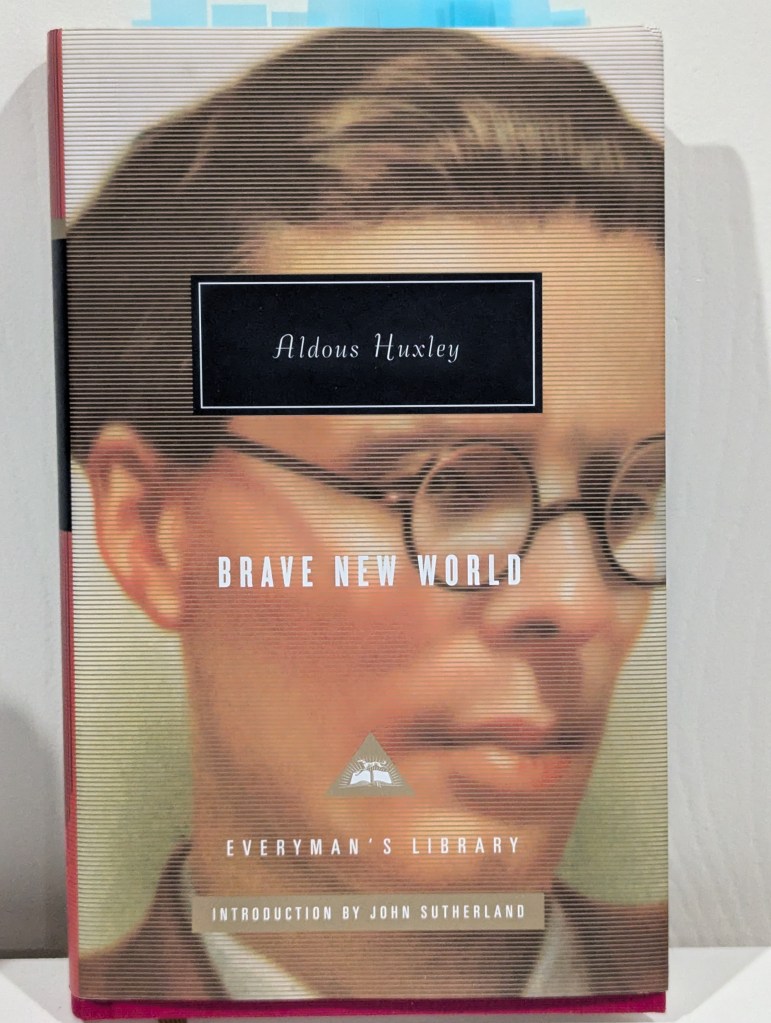
This book review is of Brave New World written by Aldous Huxley. Brave New World was published in 1932. I read a hard cover version of the book with dimensions 8 1/2″ high by 5 1/4 wide, which makes it comfortable to hold while reading. The book is 232 pages long, making it a fairly easy read in terms of time. The book has a nice Introduction that explains the premise of the book and some of the philosophy that Huxley borrowed from. What follows is a Notes section, Bibliography, and a Chronology of the life and events of the author, and then finally the chapters of the book. My hardcover version of the book is published by Everyman’s library in London, UK. The book has a nice cover, a relatively large font that is easy to read, high quality paper, and even includes a ribbon book mark. Overall this is a super nice, high quality book that makes a great collector item for your library.
Summary
If you read George Orwell’s 1984 you familiar with a society that was controlled by force and constant monitoring. Brave New World adopts a much different paradigm for controlling the population. In Huxley’s world the government uses eugenics to tightly control birth and create different classes of people. Aldous Huxley borrows many of his ideas about society from H. G. Wells, Bertrand Russel, J. B. Watson Behaviorism, and Vilfredo Pareto. From Pareto, a philosopher he uses General Sociology where the state is not run by dictators but by a management approach to society. From Watson he gets many of his ideas on what is referred to as conditioning. In Huxley’s Brave New World the masses are controlled by consumerism, conditioning, class, sexual promiscuity, and a drug called Soma. The people in this world are made so comfortable that they cease the desire for any form of personal expression and are rewarded by going along with the program.
In Brave New World there is no traditional family and as such no mother or father. In the first couple of chapters the book explains the process of how human beings are created and grown in test tubes in large factories. The government manipulates this process to produce different classes of people such as Alpha Plus, Alpha’s, Beta’s, and Epsilon’s. There may be other classes, but you get the idea. The higher level jobs in this society go to the Alpha Plus and Alpha’s, while what we might call factory worker jobs go to the Beta’s and Epsilon’s. This scientific breeding process is setup to create a particular class who’s numbers are created to fit the demand in the society.
I won’t go into the plot in any level of detail as that would spoil it for you, and I make an effort not to retell the story in all my reviews. Understand, that what we see from some of the primary characters is an awakening to the conditioning that this society has imposed upon them. The conditioning of the society happens as soon as the person is just a baby through repetition that teaches them that things that might inspire any sense of freedom are bad. In this society there are few books and the ones that exist are only those created by the state. Sensuality is a big theme of this society, with events that help to create lust in the public, encouraging multiple partners, and of course the appropriate birth control and hormone enhancement.
Unlike in Orwell’s 1984 those people that violate the society’s norms are not tortured, but instead attempts are made to reform them, and when that doesn’t work they are exiled. This removes the free thinkers from society, isolates them, and thus stability is maintained. A conscious effort was made to remove all traces of the past including museums and books published prior to a specific date. As the society that Huxley describes is based on consumerism the manufacture of goods and consumption becomes their religion if you will. Henry Ford has become a revered figure through what is called Fordism. When the populace has free time on their hands they are encouraged to consume Soma, which creates a high that lasts for hours and sometimes days depending on the dose. This creates a euphoria that masks any mental pain they may be experiencing and is a key component to keeping the people servile.
Overall in Brave New World we have a society without emotions, critical thinking skills, or even violence. A society that is in lock step to produce for the state and be easily managed. Reminds me of what we are progressing towards in the modern day Western world.
Recommendation
While I struggled with the first couple chapters, it was worth it as they built a foundation for understanding this dystopian society that Huxley writes about. I really enjoyed reading Brave New World and the ending is much as you might expect. This is not a book about the triumph of mankind over the machine, but really just the opposite. In this society science that leads to production and control over the populace is the goal, not science for the sake of discovery. It would not be too difficult to imagine our own society becoming this Brave New World. I would think Huxley was providing a warning for us, showing how easily we could be trapped into a world where pleasure is the primary goal along with the stability of the state at all costs. Highly recommended and a fairly quick read. Brave New World is a blueprint for controlling society using the carrot and not the stick.
About the Author
Aldous Leonard Huxley; 26 July 1894 – 22 November 1963) was an English writer and philosopher. His bibliography spans nearly 50 books, including non-fiction works, as well as essays, narratives, and poems.
Born into the prominent Huxley family, he graduated from Balliol College, Oxford, with a degree in English literature. Early in his career, he published short stories and poetry and edited the literary magazine Oxford Poetry, before going on to publish travel writing, satire, and screenplays. He spent the latter part of his life in the United States, living in Los Angeles from 1937 until his death. By the end of his life, Huxley was widely acknowledged as one of the foremost intellectuals of his time. He was nominated for the Nobel Prize in Literature nine times, and was elected Companion of Literature by the Royal Society of Literature in 1962.
References
About the Author – https://en.wikipedia.org/wiki/Aldous_Huxley
“Copyright 2025 InspirationalBookReviews.com. All Rights Reserved”
Please check out my companion blog thestoicbuddhist.com
I appreciate all comments and likes. Please follow my blog and you will be emailed notification of all new posts.
Namaste
 Inspirational Book Reviews