Summary
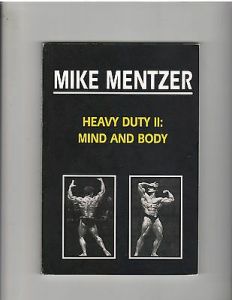
As someone who has lifted weights for years, I thought it might be a good time to review a book on the subject. This review is on the book “Heavy Duty II: Mind And Body” by Mike Mentzer. I recently re-read this book looking for some inspiration and possibly to change the way I was training as my results were less than outstanding. This book is as much a philosophical experience as it is a book on exercise science. Mike Mentzer goes into a lot of detail dispelling the myths that the bodybuilding community has been pushing such as the number of sets and training frequency needed to build muscle. He often refers to the work of philosophers and authors particularly Ayn Rand. The first couple of chapters are really about philosophy where discussions of the scientific approach to exercise and life make up the majority of those chapters. Mentzer focuses on man’s rational mind and the need to prove out what works by using a scientific approach.
Mike Mentzer’s approach, in a nutshell, is that most of us are overtraining and not giving our bodies enough time to adapt to the stress and grow. He goes into great detail based on his experience with people that he has trained why we need to regulate the frequency of training. The other primary theme is that we are doing too many exercises and too many sets. Mike advocates we do one or two warmup sets and then a set to failure. The premise here is that the set to failure insures that you have created the exact amount of stress to stimulate growth, no more or no less. To illustrate these concepts the following is an example of a routine from the book:
- Monday – Chest & Back
- Friday – Legs
- Tuesday – Delts & Arms
- Saturday – Legs (again)
Notice there are 3 days of not training between a scheduled workout and then an additional 1/2 day off on each of the training days. So let’s say you train at 4:00 p.m. on Monday, then have Tuesday, Wednesday, Thursday off, and train again on Friday at 4:00 p.m. you have 4 days between training sessions or 4 x 24 = 96 hours. This is your target no less than 96 hours between brief but intense training to failure sessions. Each session will only include 3 – 5 exercises with 1 set to failure on each exercise.
What I really liked:
This book will challenge what you have always been told, mostly around how many sets you need to stimulate growth and probably your premise that if I only train every 4 or 5 days that I will lose muscle (detrain). If you read the book carefully Mike Mentzer provides evidence from hundreds of his clients that will help you feel more comfortable giving it a try. I know I was initially skeptical, but over the course of a couple months, I quit worrying about it and found I was getting better results, working out of shorter periods of time, and working out less frequently. So a big bonus here is you might actually get to the point where you are only working out with weights once a week and you spend the rest of the time recovering, growing, and have time for other things.
What was challenging:
The first two or three chapters are very much a journey into Objectivism and rational thinking. It turns out Mike Mentzer was not just some crazy steroid taking bodybuilder, but he was actually a pretty well-read philosophical thinker. I am a great lover of Ayn Rand and her philosophy, but even I found the first few chapters a challenge to read, but hang in there it all comes together by chapter 4. The chapters focused on science and philosophy actually help you begin to challenge what you believed about bodybuilding and ultimately you will apply a more scientific approach to your training.
Recommendation:
I highly recommend this book, especially for anyone whos training has hit a plateau. It is likely you are either overtraining or maybe just going through the motions and not training as intensely as possible. Instead of just advocating 3 to 5 sets and countless exercises, the author makes the case for using a scientific approach to your training an approach based on data and inspection versus just following the herd. Once you get past the first couple chapters it becomes a pretty easy read; the paperback version I have is only 163 pages so this is something you could read in a day or two.
Enjoy!
If you would like to support this blog check out my Resources page for lots of great products.

Body, Mind & Spirit eBooks

Get 2 AudioBooks Free and 720,000 Free Podcasts!
About the Author
Mike Mentzer
From Wikipedia, the free encyclopedia
Jump to navigationJump to search
Early life and education[edit]
Mike Mentzer was born on November 15, 1951 in Ephrata, Pennsylvania and grew up there. In grammar school and Ephrata High School, he received “all A’s”, He credits his 12th grade teacher, Elizabeth Schaub, for his love “of language, thought, and writing.” In 1975, he started attending the University of Maryland as a pre-med student where his hours away from the gym were spent in the study of “genetics, physical chemistry, and organic chemistry.” After three years he left the university. He said his ultimate goal during that period was to become a psychiatrist.[1][5]
Bodybuilding career[edit]
Amateur[edit]
Mentzer started bodybuilding when he was 12 years of age at a body weight of 95 lb (43 kg) after seeing the men on the covers of several muscle magazines. His father had bought him set of weights and an instruction booklet. The booklet suggested that he train no more than three days a week, so Mike did just that. By age 15, his body weight had reached 165 lb (75 kg), at which Mike could bench press 370 lb (170 kg). Mike’s goal at the time was to look like his bodybuilding hero, Bill Pearl. After graduating high school, Mentzer served four years in the United States Air Force. It was during this time he started working out over three hours a day, six days a week.[1]
Mentzer started competing in local physique contests when he was 18 years old and attended his first contest in 1969. In 1971, Mentzer entered and won the Mr. Lancaster contest. In 1971 he suffered his worst defeat, placing 10th at the AAU Mr. America, which was won by Casey Viator. Mentzer considered his presence at this contest important later on, as he met Viator, who gave Mentzer the contact information for his trainer Arthur Jones. Due to a severe shoulder injury, he was forced to quit training from 1971 to 1974. In early 1975, however, he resumed training and returned to competition in 1975 at the Mr. America contest, placing third behind Robby Robinson and Roger Callard. Mentzer went on to win that competition the next year, in 1976. He won the 1977 North America championships in Vancouver, British Columbia, Canada, and competed a week later at the 1977 Mr. Universe in Nîmes, France, placing second to Kal Szkalak. In 1978, Mentzer won the Mr. Universe in Acapulco, Mexico with the first and only perfect 300 score. He became a professional bodybuilder after that 1978 Universe win.[1][2]
Professional[edit]
In late 1979, Mentzer won the heavyweight class of the Mr. Olympia, again with a perfect 300 score, but he lost in the overall to Frank Zane who was awarded the title for a third time that year. In the 1980 Mr. Olympia he placed fourth (in a tie with Boyer Coe) behind Arnold Schwarzenegger, Chris Dickerson and Frank Zane.[6]
Retirement[edit]
He retired from competitive bodybuilding after that show at the age of 29. He maintained that the contest was rigged until the day he died. While he never said he thought that he should have won, he maintained that Arnold should not have, though he eventually got on good terms with Schwarzenegger.[6][1]
In 2002, Mentzer was inducted into the IFBB Hall of Fame.[2]
Bodybuilding philosophy[edit]
Mentzer was an Objectivist and insisted that philosophy and bodybuilding are one and the same. He said “Man is an indivisible entity, an integrated unit of mind and body.” Thus, his books contain as much philosophy as they do bodybuilding information.[1]
Mentzer took the bodybuilding concepts developed by Arthur Jones and attempted to perfect them. Through years of study, observation, knowledge of stress physiology, the most up-to-date scientific information available, and careful use of his reasoning abilities, Mentzer devised and successfully implemented his own theory of bodybuilding. Mentzer’s theories are intended to help a drug-free person achieve his or her full genetic potential within the shortest amount of time.[7]
High-Intensity Training the Mike Mentzer Way was Mentzer’s final work. In it, he detailed the principles of high intensity weight training. Weight training, he insisted, had to be brief, infrequent, and intense, to attain the best results in the shortest amount of time. Heavy Duty II also espouses critical thinking. In this book, Mentzer shows why people need to use their reasoning ability to live happy, mature, adult lives, and he shows readers how to go about doing so. Bodybuilding was endorsed as only one potential component of an individual’s existence, encouraging many other worthwhile pursuits throughout his books.[8]
Diet and nutrition[edit]
Diet has always been as important, if not more, as weight-training for bodybuilders. However, in his book Heavy Duty Nutrition, Mentzer demonstrated that nutrition for athletes did not need to be nearly as extreme as the bodybuilding industry would lead one to believe. His recommended diets were well balanced, and he espoused eating from all four food groups, totaling four servings each of high-quality grains and fruits, and two each of dairy and protein daily, all year-round.[9]
Mentzer believed that carbohydrates should make up the bulk of the caloric intake, 50–60%, rather than protein as others preferred. Mentzer’s reasoning was simple: to build 10 pounds of muscle in a year, a total of 6000 extra calories needed to be ingested throughout the year, because one pound of muscle contains 600 calories. That averages 16 extra calories per day, and only four of them needed to be from protein—because muscle is 22% protein, about one quarter.[9]
Mentzer’s heavy-duty training system[edit]
While Mike Mentzer served in the US Air Force, he worked 12-hour shifts, and then followed that up with ‘marathon workouts’ as was the accepted standard in those days. In his first bodybuilding contest, he met the winner, Casey Viator. Mentzer learned that Viator trained in very high intensity (heavy weights for as many repetitions as possible, to total muscle fatigue), for very brief (20–45 minutes per session) and infrequent training sessions. Mentzer also learned that Viator almost exclusively worked out with the relatively new Nautilus machines, created and marketed by Arthur Jones in DeLand, Florida. Mentzer and Jones soon met and became friends.[10]
Jones pioneered the principles of high-intensity training in the late 1960s. He emphasized the need to maintain perfectly strict form, move the weights in a slow and controlled manner, work the muscles to complete failure (positive and negative), and avoid overtraining. Casey Viator saw fantastic results training under the direction of Jones, and Mentzer became very interested in this training philosophy.[10] Eventually, however, Mentzer concluded that even Jones was not completely applying his own principles, so Mentzer began investigating a more full application of them. He began training clients in a near-experimental manner, evaluating the perfect number of repetitions, exercises, and days of rest to achieve maximum benefits.[7]
For more than ten years, Mentzer’s Heavy Duty program involved 7–9 sets per workout on a three-day-per-week schedule.[7] With the advent of “modern bodybuilding” (where bodybuilders became more massive than ever before) by the early 1990s, he ultimately modified that routine until there were fewer working sets and more days of rest. His first breakthrough became known as the ‘Ideal (Principled) Routine’, which was a fantastic step in minimal training. Outlined in High-Intensity Training the Mike Mentzer Way, fewer than five working sets were performed each session, and rest was emphasized, calling for 4–7 days of recovery before the next workout.[8] According to Mentzer, biologists and physiologists since the nineteenth century have known that hypertrophy is directly related to intensity, not duration, of effort (Mentzer 2003;39). Most bodybuilding and weightlifting authorities do not take into account the severe nature of the stress imposed by heavy, strenuous resistance exercise carried to the point of positive muscular failure.[7]
Mentzer’s training courses (books and audio tapes), sold through bodybuilding magazines, were extremely popular, beginning after Mentzer won the 1978 IFBB Mr. Universe contest. This contest gathered a lot of attention, because at it he became the first bodybuilder ever to receive a perfect 300 score from the judges. Some time later, Mentzer attracted more attention when he introduced Dorian Yates to high-intensity training, and put him through his first series of workouts in the early ’90s.[7] Yates went on to win the Mr. Olympia six consecutive times, from 1992 to 1997.
Contest history[edit]
- 1971 Mr. Lancaster – 1st
- 1971 AAU Mr. America – 10th
- 1971 AAU Teen Mr America – 2nd
- 1975 IFBB Mr. America – 3rd (Medium)
- 1975 ABBA Mr. USA – 2nd (Medium)
- 1976 IFBB Mr. America – 1st (Overall)
- 1976 IFBB Mr. America – 1st (Medium)
- 1976 IFBB Mr. Universe – 2nd (MW)
- 1977 IFBB North American Championships – 1st (Overall)
- 1977 IFBB North American Championships – 1st (MW)
- 1977 IFBB Mr. Universe – 2nd (HW)
- 1978 IFBB USA vs the World – 1st (HW)
- 1978 IFBB World Amateur Championships – 1st (HW)
- 1979 IFBB Canada Pro Cup – 2nd
- 1979 IFBB Florida Pro Invitational – 1st
- 1979 IFBB Night of Champions – 3rd
- 1979 IFBB Mr. Olympia – 1st (HW)
- 1979 IFBB Pittsburgh Pro Invitational – 2nd
- 1979 IFBB Southern Pro Cup – 1st
- 1980 IFBB Mr. Olympia – 5th
Personal life[edit]
Atheism[edit]
Mentzer was an atheist,[11] and stated in the last interview before his death that he did not believe in God, heaven, hell, or any kind of afterlife.[12]
Objectivism[edit]
While in school, Mentzer’s father motivated his academic performance by providing him with various kinds of inducements, from a baseball glove to hard cash. Years later, Mike said that his father “unwittingly … was inculcating in me an appreciation of capitalism.”[1]
According to David M. Sears, a friend of Mentzer and an editor and publisher of his Muscles in Minutes book, he stated that:[1]
As you know, Mike was a voracious reader of philosophy in college-so that would put him at, say 18 years old, in 1970. He read the more traditional philosophers then, and “probably” didn’t fully embrace Ayn Rand until the mid- or later 1980s (since none of his writings mentioned her until at least the mid-80s if not later). In my opinion, Mike’s ideas on bodybuilding were “allowed” to emerge because of his Objectivism. His approach to critical thought, analytical thinking, and knowing there is one truth, all allowed him to buck conventional thought and push onward with his own mental effort.
Regarding what he learned from Ayn Rand, Mentzer said in an interview:[1]
Learning logic and acquiring the ability to think critically is not easy, though not impossibly difficult. I learned how to do these things by reading and “digesting” the works of novelist/philosopher, Ayn Rand. To get started on the proper, methodical path read her books of explicit philosophic essays Philosophy: Who Needs It— especially the Introduction and the first two chapters – and The Romantic Manifesto – especially the second chapter, “Philosophy and Sense of Life.” After reading and re-reading the first couple of chapters from each of those books, put them aside for a while and read her two epochally great novels–The Fountainhead and Atlas Shrugged, in that respective order. Just as is true with any other context of knowledge, philosophy must be studied in a logically structured order …
In his last interview before his death, Mentzer said he was delighted to get so many phone clients and close personal bodybuilding friends, such as Markus Reinhardt, who had been influenced by him to become Objectivists. He described Objectivism as the best philosophy ever devised. He also criticized the philosophy of Immanuel Kant, which he described as an “evil philosophy,” because according to him Kant set out to destroy man’s mind by undercutting his confidence in reason. He also criticized the teaching of Kantianism in schools and universities and said it’s very difficult for an Objectivist philosopher with a PhD to get a job in any of the universities.[12]
Final years and death[edit]
In the late ’80s, Mentzer returned to training bodybuilders and writing for Iron Man magazine and spent much of the 1990s regaining his stature in the bodybuilding industry. Mike had met Dorian Yates in the 1980s and made an impression on Dorian’s bodybuilding career. Years later when Yates won Joe Weider’s “Mr. Olympia”, he credited Mike’s “Heavy Duty” principles for his training. Mike, his brother Ray, and Dorian formed a clothing company called “MYM” for Mentzer Yates Mentzer, also known as “Heavy Duty Inc”, in 1994. MYM was based on the success of Don Smith’s “CrazeeWear” bodybuilding apparel. The three principals wanted to capitalize on the physically fit lifestyle, which today has gone mainstream. With the blessing and promotion of Joe Weider, the trio manufactured and distributed their own line of cut-and-sew sportswear.[1]
Mentzer died on June 10, 2001 in Rolling Hills, California. He was found dead in his apartment, due to heart complications, by his younger brother and fellow bodybuilder Ray Mentzer. Two days later, Ray died from complications from his long battle with Berger’s disease.[3]




 Inspirational Book Reviews