Tag: Anton Chekhov

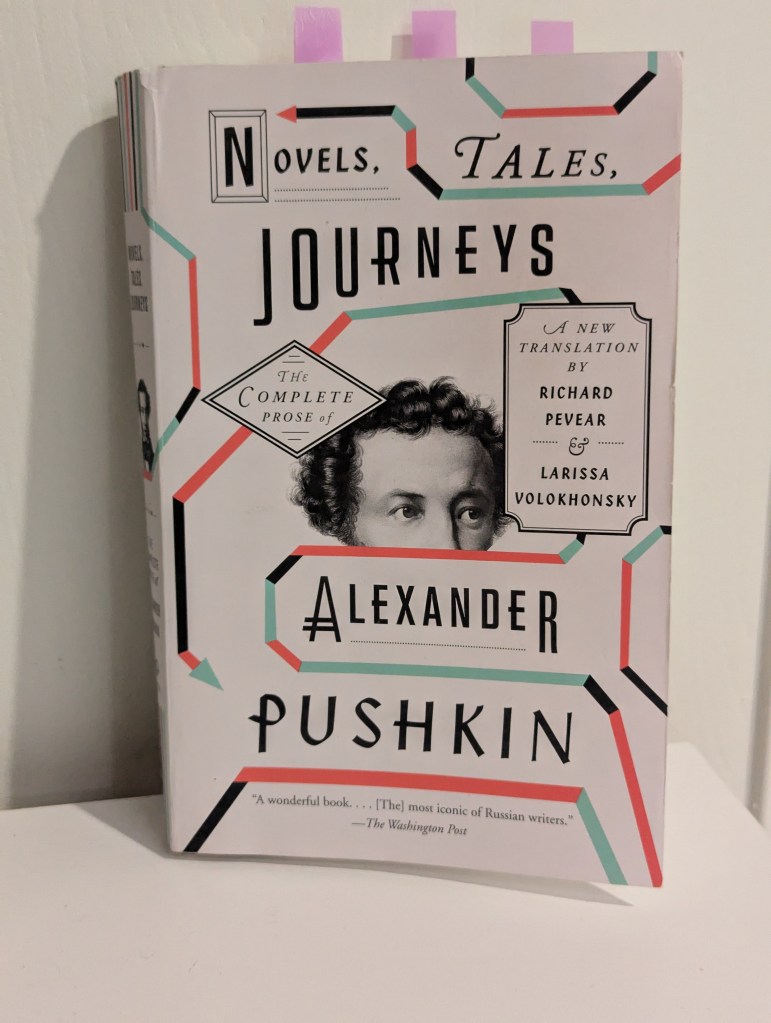
Novels, Tales, Journeys – Alexander Pushkin

About this book

The stories in Novels, Tales, Journeys were written by Alexander Pushkin translated by Richard Pevear and Larissa Volokhonsky. This book is the complete prose of Alexander Pushkin and as such it doesn’t include his poetry, but instead has a number of stories that he wrote. The book dimensions are 8″” high x 5 1/4″ wide and consists of some 484 pages. I have the paperback version, which is well constructed with nice cover and well printed pages. There is an Introduction, 10 stories, a section of Fragments and Sketches, and a Notes section.

Summary

As this is a collection of Pushkin’s prose I won’t be able to say there is a plot to this writing. I am a big fan of Russian writers having read all of Fyodor Dostoevsky’s novels and stories, Anton Chekhov’s stories, and a couple books by Aleksandr Solzhenitsyn. Pushkin proceeded all the authors I just mentioned, although there was some overlap with the life of Dostoevsky. One of the more interesting stories was called Dubrovsky, which was also one of the longer ones at 60 pages. The story of Dubrovsky had all the great elements including revenge, love, and intrigue. The Captains Daughter was another favorite for me and was over 100 pages, which makes it the longest story in the book. I also enjoyed The Queen of Spades a story about gambling and greed, one of Pushkin’s vices. As with reading Dostoevsky or Chekhov, you will be glancing back through the pages at times to determine who Pushkin is referencing. This has to do with the author referencing anyone of three names for a character or even abbreviated names. This may have slowed me down at times, but it was worth the effort. Even though I only mentioned these three stories all of the other stories are also very entertaining.

Recommendation

Pushkin is very skilled at describing the settings for the stories and the characters. His ability to pull you into the time period is outstanding. You feel like you are right there in early 19th century Russia with its nobility, serfs, terrible weather, alcohol addiction, military campaigns, and the ridiculous lack of medical science that accounted for the infant mortality and the short life span of the people. You also get a understanding of the ties between Russia and European countries especially France and Germany and the imprint it had on Russian society via art, literature, language, and fashion.

I read about half the book some time ago, and picked it up again starting over from the beginning. Reading about one story or part of the longer ones each day. It took me about two weeks to finish the book. I thoroughly enjoyed every page; looking forward to reading each day. If you are searching for a book that you can really enjoy and you have an interest in Russian literature then Novels, Tails, Journeys is a wonderful choice. Pushkin was in a league of his own and is still regarded as Russia’s greatest poet and story teller. In my own opinion I put him in the same class of Russian authors as Dostoevsky or Chekhov. Now with that said I have yet to tackle Tolstoy; more on that in the future.

About the author

Alexander Pushkin (1799 – 1837) dying at just 37 years old in a duel was a playwright, poet, and novelist who became prominent before he was 20 years old. He participated in some radical politics that had him banned from the Russian capital a couple times.

Pushkin was born into the Russian nobility in Moscow. His father, Sergey Lvovich Pushkin, belonged to an old noble family. One of his maternal great-grandfathers was Major-General Abram Petrovich Gannibal, a nobleman of African origin who was kidnapped from his homeland by the Ottomans, then freed by the Russian Emperor and raised in the Emperor’s court household as his godson.

He published his first poem at the age of 15, and was widely recognized by the literary establishment by the time of his graduation from the Tsarskoye Selo Lyceum. Upon graduation from the Lycée, Pushkin recited his controversial poem “Ode to Liberty”, one of several that led to his exile by Emperor Alexander I. While under strict surveillance by the Emperor’s political police and unable to publish, Pushkin wrote his most famous play, Boris Godunov. His novel in verse Eugene Onegin was serialized between 1825 and 1832. Pushkin was fatally wounded in a duel with his wife’s alleged lover and her sister’s husband, Georges-Charles de Heeckeren d’Anthès, also known as Dantes-Gekkern, a French officer serving with the Chevalier Guard Regiment.

Reference regarding the author: https://en.wikipedia.org/wiki/Alexander_Pushkin

“Copyright 2025 InspirationalBookReviews.com. All Rights Reserved”

Please check out my companion blog thestoicbuddhist.com

I appreciate all comments and likes. Please follow my blog and you will be emailed notification of all new posts.

Namaste

The Greatest Short Stories of Anton Chekhov

About the Book

I own the paperback version of The Greatest Short Stories of Anton Chekhov. The book was translated by Constance Garnett who in addition to translating the stories to English also wrote a short bio of Anton Chekhov. This book is 623 pages long and the print is a comfortable 10 pitch so it is easy to read. Most of the stories in the book are just a few pages long with the exception of three or four stories over 20 pages in length. After reading a number of short stories the next one was called “A Dreary Story” and it was 63 pages long. I only noticed maybe a half dozen misprinted words, which was a bit odd to me, but overall the quality of the paperback version is excellent.

Summary

This is a compilation of 50 stories written by Chekhov over about a 20-year period from 1883 through 1903. One of the cool things is that the translator shows when the story was first published and where it was published. While only living 44 years Anton Chekhov wrote 522 stories over his short life and a number of plays. This book as titled is supposed to be a compilation of his greatest stories. To put things in context these stories by Chekhov were written prior to the Bolshevik (Russian) Revolution that started in 1917. There are several things that stand out about Russian society when you are reading these stories.

  • The disparity between the rich and poor was monumental. Many of the people in Russia at that time were serfs or peasants who worked in various trades, but were little more than slaves in Russian society.
  • Alcoholism was rampant in Russia during the late 1800’s. I suspect it is not that much better today.
  • The state of medicine as a profession in comparison to today was abysmal. Life expectancy was 30-35 years much of this due to infant mortality and the state of health care at the time.
  • In many of the stories, characters were thought to be dying of consumption, viruses, fever, alcoholism, and madness.
  • The weather well was as you might expect with long wet winters that made travel on dirt roads that were typical of the period difficult at best.

Of course in the late 1800’s this would not have been unique to Russia and my guess is that many of these issues existed in many parts of the world. However, there is something special about how Chekhov described the plight of his characters. Each story is different and has a special message for the reader. Chekhov had an incredible talent for describing things like the weather, scenery, or the emotions of his characters. In a way, this is not unusual given he was a playwright.

I would typically read one or two stories a day, so if you have limited time this book allows you to read a story and not have to worry about if you remember where you left off as is the case with a novel. The writing is clear and easy to read without some of the complexity you might find with other Russian authors such as Fyodor Dostoevsky. Much of these stories is dialog between characters and there were times I had to figure out who was saying what to who, but that was not a frequent issue. If you are new to reading Russian literature you may be a bit confused about the names, but after a while, you will figure it out. If you want to learn more about Russian names check out this blog post by Janet Fitch, it does a nice job of explaining how Russian names work.

Recommendation

This is one of my favorite books and while it is over 600 pages long the fact that it contains so many interesting stories allows you to consume a story in one sitting and the book as a whole over time without getting lost. Chekhov has a real talent for describing a scene and his characters. You feel like you are being taken back to the Russia of the late 1800s and you are experiencing the joy and tragedy of the characters in the story. I can understand why Tolstoy was such a fan of Chekhov and I will be seeking more of his work to read. Without getting too emotional about Chekhov’s work, I enjoyed reading all 50 stories in this book. I highly recommend this book to anyone who enjoys great writing and wants to go back in time and understand the culture of Russia during that time period. I would put Chekhov right near the top of the greatest Russian writers and maybe the greatest short story writer of all time.

About the Author

There is a nice 4-page bio of Anton Chekhov at the beginning of the book. Chekhov was an extremely influential author and there is a lot of information about his life and his work. I’m going to provide what I found online at Britannica as it seemed the most readable and best organized.

Anton Chekhov Summary

Anton Chekhov, (born Jan. 29, 1860, Taganrog, Russia—died July 14/15, 1904, Badenweiler, Ger.), Russian playwright and short-story writer. The son of a former serf, he supported his family by writing popular comic sketches while studying medicine in Moscow. While practicing as a doctor, he had his first full-length play, Ivanov (1887), produced, but it was not well-received. He took up serious themes with stories such as “The Steppe” (1888) and “A Dreary Story” (1889); later stories include “The Black Monk” (1894) and “Peasants” (1897). He converted his second long play, The Wood Demon (1889), into the masterpiece Uncle Vanya (1897). His play The Seagull (1896) was badly received until its successful revival in 1899 by Konstantin Stanislavsky and the Moscow Art Theatre. He moved to the Crimea to nurse his eventually fatal tuberculosis, and there he wrote his great last plays, Three Sisters (1901) and The Cherry Orchard (1904), for the Moscow Art Theatre. Chekhov’s plays, which take a tragicomic view of the staleness of provincial life and the passing of the Russian gentry, received international acclaim after their translation into English and other languages, and as a short-story writer, he is still regarded as virtually unmatched. https://www.britannica.com/summary/Anton-Chekhov

As I mentioned Britannica has an extensive biography on Anton Checkhov with some very interesting information about the stages of his life and career. https://www.britannica.com/biography/Anton-Chekhov

I would also point you to Wikepedia who also has some great information on the life and work of Anton Chekhov. https://en.wikipedia.org/wiki/Anton_Chekhov

Please check out my companion blog The Stoic Buddhist

“Copyright 2024 InspirationalBookReviews.com. All Rights Reserved”

Please Subscribe if you are not already following me.